Season 2, Episode 4: What Can You Do for My Black Children?
October 29, 2026
In a poor, Black neighborhood in Houston, Principal Thaddeus Lott transforms a struggling elementary school with Direct Instruction. Soon, his students are outperforming students at much wealthier schools. The results are so remarkable, some people think it’s too good to be true.
Email us: soldastory@apmreports.org
Call us: (612) 888-7323



Direct Instruction programs have long drawn criticism from educators who say they limit teacher autonomy. But surveys suggest that teachers who use the programs tend to view Direct Instruction favorably — especially when they receive training and ongoing support.
In the 1990s, a school in a poor, Black neighborhood on the outskirts of Houston garnered national attention for its student achievement. Under the leadership of Principal Thaddeus Lott, Wesley Elementary’s test scores surpassed many schools in wealthy suburbs.
When Richard Lott was a little kid, there was a special place in his neighborhood: the house his uncle had built.
Richard Lott: It was a great house. It was a two-story house.
That's what really stood out. His uncle's house had a first floor and a second floor.
Richard Lott: And I will tell you, at that time, there were no two-story houses in my neighborhood.
It was a poor neighborhood on the outskirts of Houston. His uncle had grown up there too.
(Music)
The neighborhood was called Acres Homes because the original homesites were divided by the acre. Large enough for gardens and farm animals.
Genia Blount-Hendrix: They had chickens, you know, and so they were really in a rural area that was inside urban city.
Maurice Lamb: You can be at a red light and two people on horses will pull up next to you, and that is a very normal, normal thing.
The Acres Homes neighborhood was established in the early 20th century. It became one of the largest communities of Black landowners in the South.
But by the time Richard Lott's uncle built his house there in 1969, the neighborhood was in tough shape. Parts of the community still lacked many of the basic services found elsewhere in Houston — there were unpaved roads, houses without city water or sewer. And a lot of poverty.
Thaddeus Lott: As you drive through Acres Homes, you drive through what is really a picture of what happens in many communities.
This is Richard Lott's uncle, Thaddeus Lott.
Thaddeus Lott: You may see rundown fences, what have you. But behind every one of those rundown fences is a child who has hopes and dreams and aspirations for the future.
(Music ends)
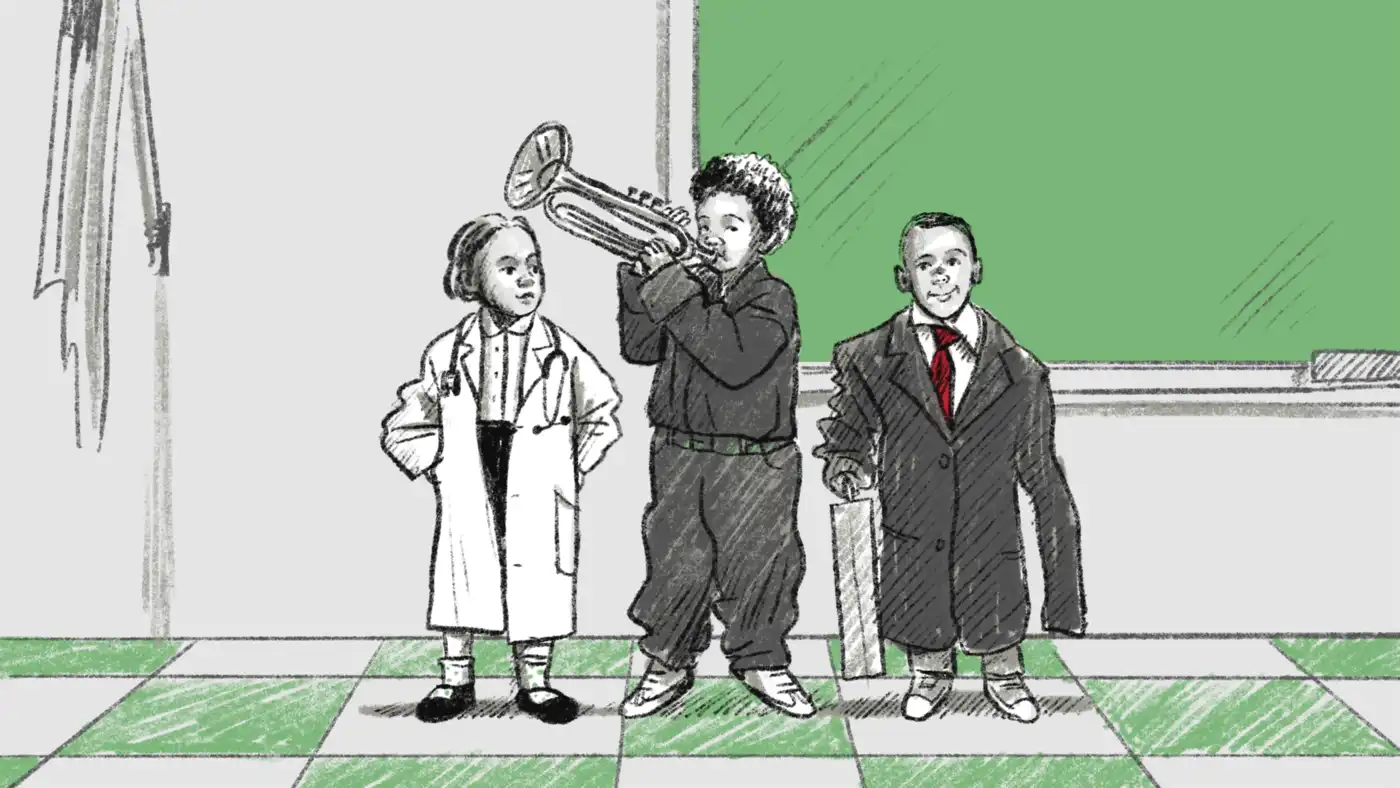
And it was those children Thaddeus Lott was thinking about when he built his house. He wanted them to see that a Black kid who grew up in Acres Homes could prosper.
(Music)
That they could make it, too.
His daughter, Shmarilyn Lott-Cassel, says one of her dad's hobbies was buying old cars and fixing them up.
Shmarilyn Lott-Cassel: Daddy loved to bring life to things.
She says he was always trying to restore things, make them better.
Lott-Cassel: Items that people would just kind of discard or throw away or consider useless, he would buy those things and rebuild them.
And that's what he was going to do with the school in his neighborhood too.
Thaddeus Lott was an educator and a few years after he built his house, he became the principal of the elementary school down the street. It was also in tough shape. And he was going to turn it into one of the highest performing schools in Texas.
I'm Emily Hanford and this is Season 2 of Sold a Story, a podcast from APM Reports. We're at Episode 4.
Poverty is one of the most daunting challenges when it comes to how kids do in school. Everyone in education knows this. There's a very strong link between academic achievement and the economic conditions children grow up in.
But schools can't control poverty. They can't change their students' homes or neighborhoods.
Schools can control instruction.
And that's what Thaddeus Lott set out to change at Wesley Elementary school in Houston in 1975.
(Music ends)
When Thaddeus Lott took over as the principal of Wesley Elementary, it was a few years into a new way of teaching reading in the Houston Public Schools.
Thaddeus Lott: The idea was that children could learn to read just by being exposed to the words. They called it whole language. And they banned the use of phonics.
It was not going well at Wesley. He said there were a lot of kids who couldn't read. So, he defied school district officials. He got rid of whole language. And replaced it with Direct Instruction.
(Music)
Thaddeus Lott had discovered Direct Instruction several years earlier. At the library … where he found a book by Zig Engelmann. A book Zig had written about all the things he'd been able to teach to the children at his preschool. Things Thaddeus Lott wanted his students to know.
Thaddeus Lott: So, I got in contact with him. He sent me some of the materials.
This was when Project Follow Through was still going on. That big government study you heard about in the last episode. Zig and his colleagues were flying all over the country helping schools do Direct Instruction. And Thaddeus Lott was in Houston, trying to do Direct Instruction on his own. He told his teachers — we're using Direct Instruction. And I don't want to hear that the kids can't learn because they're poor.
Thaddeus Lott: I don't need a teacher who's going to be sorry for these children. These children need a teacher.
(Music ends)
Some of the teachers left. And he hired new ones.
Lorraine Killion: I interviewed with Thaddeus and his first question to me is — what can you do for my Black children?
Lorraine Killion had been teaching at another Houston school.
Killion: I was kind of taken aback by his forwardness, you know, and I said, “Well, I can teach them.” And so, the next thing I knew, I was a member on board of Wesley staff.
At first, she thought maybe she'd made a mistake. She went to watch another teacher doing Direct Instruction.
Killion: She would point to something in the book and then she would give a signal and the students would respond. And I thought, “Gee, I don't know what I think about that. It seems too structured for me.”
She was used to doing her own thing. But she gave Direct Instruction a try. Because that was the job.
Killion: Once I saw what they could do and the level at which they could perform, I changed my mind. I thought — this is something I need to learn more about and buy into it, because if you stay here, this is the future. And, it was quite a ride. (Laughs)
The rule at Wesley was the same as the rule at Zig's preschool. If the kid hasn't learned it, the teacher hasn't taught it.
Teacher: OK, everybody. What's the name of our country? Get ready.
Kids: The name of our country is United States of America.
These are students at Wesley, doing Direct Instruction back in the 1990s.
Teacher: What's the name of our state, everybody?
Kids: The name of our state is Texas.
We found several old documentaries and news programs about Wesley Elementary School when Thaddeus Lott was in charge.
Girl: “This is a good house,” one dog said.
These are kindergarteners, reading books.
Boy: Walter loved to play football.
And here's a first grader …
Girl: If I were in charge of the world ….
… reading something she wrote herself.
Girl: … people who couldn't read, I would teach them how to read.
If I were in charge of the world, this little girl wrote, I would teach kids to read so they can read stories to their children and so they can read their bills.
Boy: “Beware MacDuff. Beware the Thane of Fife.”
By 5th grade, students at Wesley were reading Shakespeare.
Teacher: OK, who do you think the Thane of Fife is?
Kids: Ooh! MacDuff.
Teacher: MacDuff. OK. Go on!
Kid: “Whatever thou art, for thy good caution, thanks; Thou hast harped my fear aright.”
Sharolyn Pollard-Durodola: It was a place where I think learning took place from the moment the students stepped on the campus until when they left.
Sharolyn Pollard-Durodola was a reading coordinator at Wesley.
Pollard-Durodola: There was no time wasted on frivolous kinds of activities.
Killion: He ran a very tight ship.
This is teacher Lorraine Killion again.
Killion: He expected everyone to put in hours beyond expectation, and a lot of people came and left because they couldn't take the workload, you know. It was intense.
She says Thaddeus was almost never in his office. He was in the halls. And in the classrooms.
Killion: And he wouldn't just like walk in. He would take a chair, and he would stay for periods of time. Maybe half an hour to an hour. To a lot of people, it was unnerving to be watched under a microscope, so to speak. To me, I felt like he really cared. He would give you a pat on the back if you deserved it. But he would also point out things that he thought you could do better. He wanted everyone to meet the standards that he thought it was going to take for his school to be successful.
Jerry Silbert: The bell rang at 8 o'clock. You better be teaching at 8 o'clock.
This is Jerry Silbert.
Silbert: He'd be walking around. And if somebody hadn't started, you'd hear on the loudspeaker, “Miss Jones, Miss Jones, would you come to the principal's office, please.”
You met Jerry Silbert in the previous episode. He was one of the people working with Zig on Project Follow Through. He heard about what Thaddeus Lott was doing with Direct Instruction at Wesley. And he went to visit.
Silbert: His whole thing as a Black man — we have to be better. So the school was absolutely spotless.
Lott-Cassel: The floors were clean. Everything was neat.
His daughter Shmarilyn says he was always trying to set an example for his students.
Lott-Cassel: If they went home and saw disarray, they knew when they came to school, they saw what order looked like.
Thereasa Cox: Wesley was like a retreat for me.
Thereasa Cox was a student at Wesley. She says the school was a bright spot in her otherwise difficult childhood.
Cox: I could escape there and be safe. And I could spend all day there and nobody was wondering where I was at 'cause I was at school.
We tracked down 17 former Wesley students. And we asked them what they remember about the school.
(Music)
Mecca Dishmon: When I think of Wesley, the first thing that comes to my mind is Black excellence.
Cox: I felt like when I was getting taught at Wesley, I was allowed to be Black and to be smart.
Tomyka LaRue-Wimberley: I just loved it.
Tommy Lee: You wanted to do good.
Tonicia Wimberley: My confidence was built there.
Richard Lott: We were excited about learning.
They remember things they learned.
LaRue-Wimberley: We all had perfect handwriting.
Lamb: Reading Shakespeare.
LaRue-Wimberley: The grammar rules, you know.
Lee: We were dissecting frogs. Learning how to grow plants.
And it wasn't all academics.
Wimberley: I found my love for music there.
LaRue-Wimberley: She took us to the Renaissance Festival.
Lee: Going to baseball games and stuff like that.
LaRue-Wimberley: To this day, I love the Astros. (Laughs)
(Music ends)
The people who remember going to Astros games and the Renaissance Festival were Lorraine Killion's students. She ended up with a core group of kids she taught for three years in a row, grades 3 through 5. It was kind of a little experiment — to see how far the kids could go with a good teacher and a good curriculum. Lorraine Killion says once her students mastered the basics, they really took off.
Killion: And a lot of times they would come up with responses that I'm thinking, “Wow, I didn't think of that. That's really good.”
The students in her class started referring to themselves as “Killion's kids.” They knew they were being taught in a way that was different from other schools. And they knew about Zig. They asked if they could write him letters.
Killion: Well, they started writing back and forth and Engelmann used to say — Killion, are you telling them what to write? I mean some of the letters that they're writing sound like maybe you wrote it. And I'm like — no, I don't have time to be writing for them.
Zig was impressed by their handwriting, their spelling, their use of language and vocabulary. He said in his memoir that one of Killion's kids wrote to him — “Why haven't you answered my last letter? Are you indolent?”
That's a fancy word for lazy.
(Music)
By the early 1990s — 15 years after Thaddeus Lott had become principal — Wesley had become not only one of the highest performing schools in Houston. It had become one of the highest performing schools in the entire state of Texas.
Tommy Lee — who was one of Killion's kids — says he will be forever grateful for Wesley. A good school in a poor neighborhood — it changes the game.
Lee: You had these little young kids in Acres Homes wanting to be doctors and lawyers and stuff like that. And it was realistic.
Wesley hadn't become the best school in Houston. There were still about 20 schools — all with higher income populations — that were scoring better than Wesley. But Wesley was doing better than some schools in wealthy, white neighborhoods. And no school with as many kids from poor families was performing anywhere close.
Thaddeus Lott: That was the joy in doing what we did, was to prove that just because they're poor, they're not stupid, not dumb. You give them an outstanding teacher and someone who believes in them. And they never failed us, they never did.
(Music ends)
Thaddeus Lott hadn't changed his students' homes or their neighborhood. But he had changed the way they were taught.
(Music)
Coming up, other schools take notice of what's happening at Wesley.
And some people think — it can't be real.
That's after a break.
**
(Music)
The word was getting out about Wesley Elementary School.
Towanna Bazile: We had visitors in the class all the time.
Towanna Bazile was one of Killion's kids.
Bazile: Because of who we were, because of who she was, because of how successful we were.
Some days there were dozens of visitors. Jerry Silbert remembers a tour with some businesspeople.
Silbert: We started visiting a couple of classrooms — kindergarten classrooms — where the kids were doing very well. Kids could read — say, wow, you know, it was really very impressive.
But he noticed some skeptical expressions.
Silbert: Say, “OK, you're showing us the high kids. Let us see the other classrooms.” So, we go to all the classrooms.
(Music)
And in every classroom, they saw Black kids from poor families reading and learning and doing really well. And the looks on the visitors' faces changed.
Silbert: As they walked around, they said, “Oh, it's possible. We've always said that it's possible, but we never really saw it. Today has put something in us that we didn't have before. Now we know it's really possible.” I remember one guy, he owned a trucking company. He was kind of a tough guy. Nice man, but he was — you know, you could tell. And he was so touched by it. He said, “I can just barely talk after seeing this. You know, this, this makes my year.”
And it wasn't just businesspeople visiting Wesley. Other educators were coming … from all over the country.
Blount-Hendrix: We took them all down to Houston, Texas with us. It must have been, oh it was close to 40 people that went.
Genia Blount-Hendrix visited with a group of educators from Columbus, Ohio.
Blount-Hendrix: It was really great cause we saw them doing science, we saw them doing math.
The educators were just as astonished.
Blount-Hendrix: Their mouths were open. (Laughs) They were literally — had their mouths open, covering their mouth, like in amazement.
(Music ends)
But there were people who were not pleased with what Thaddeus Lott was doing.
Ramon Alvarez: They were heckling this Black principal in North Houston.
Ramon Alvarez had just gotten a job as a principal in a different part of the city. He was at a meeting with his boss, an assistant superintendent, and other principals in his area. And he heard some of them ripping into this guy named Thaddeus Lott.
Ramon Alvarez: Because he was teaching drill and kill and he was ruining kids.
Ramon didn't pay much attention. He had enough to worry about at his own school.
Ramon Alvarez: There were a lot of kids who did not know how to read.
It was a low-income school full of Hispanic kids. He was trying to figure out what to do. And one day, while he was visiting classrooms in his building, he went into a special education class. And the students were all reading fluently. He took the teacher aside.
Ramon Alvarez: I thought you were teaching special ed kids. And she says, “I am.” I said, “But it can't be, because these kids read very well.” I had just come from other regular classrooms and the kids don't know how to read. And she says, “Well, it's the approach I'm using.” I said, “What is that?” She says, “Direct Instruction.” So, I said, “Well, why aren't we using it here throughout the school?” And she says, “Well, a lot of times people don't like it.” I said, “Why?” She said, “Well, that's just the way it is.”
But she told him — there's a Black principal in North Houston using Direct Instruction throughout his school. And Ramon Alvarez put two and two together — it was the principal his colleagues and the assistant superintendent had been ripping into. He decided he had to see it for himself.
(Music)
So, he went to visit.
Ramon Alvarez: I saw kids in kindergarten reading, like unbelievable. I mean it was actually reading, not looking at pictures. So, I said, “That is exactly what I want for my school.”
He told his staff what he'd seen.
Ramon Alvarez: Our scores are like 30% passing. I said, “That doesn't have to be that way.”
This was personal for Ramon.
Ramon Alvarez: I was one of those kids. I grew up, you know, poor.
He asked Thaddeus Lott for help.
Ramon Alvarez: He used to call me “young man.” That was my name, young man.
Thaddeus taught Ramon what he knew about Direct Instruction and running a successful school.
Eventually there was an article in the newspaper about how the two of them were working together. And Ramon's boss didn't like it.
Ramon Alvarez: The assistant superintendent calls me in and he says, “What's this?” He says, “There's an article here that you're associated with Thaddeus Lott.” He says, “I don't want any Thaddeus Lotts.”
(Music ends)
That's what he told me.
Thaddeus Lott had been defying school district officials for years. And they didn't trust him. In fact, they suspected he was cheating.
Gayle Fallon: We've had them come in and say, we think they're cheating at Wesley. Can you find out how they're doing it?
This is Gayle Fallon, who was the head of the Houston teacher's union, in an interview with Chris Wallace of ABC News in 1991.
Chris Wallace: Why the suspicion?
Fallon: I think they suspect them because they are poor, Black children and because in the mindset in the administration they don't believe poor, Black children can outperform suburban white children. And they are doing it. And they are doing it routinely.
Wallace: Ms. Fallon, you're, you're making a very serious charge.
Fallon: Right.
Wallace: You're basically accusing the school district, the top administrators, of racism.
Fallon: Yes. I think probably racism of the worst kind. You know, it's not even conscious racism. It's a racism of lowering your expectations for minority students.
Raymond: That's totally fallacious. It's absolutely not true.
That's the response Chris Wallace got from the Houston superintendent. And people in the Acres Homes neighborhood were not buying it … as Wallace reported on ABC.
Wallace: The community even voiced its anger in church.
Pastor: We understand that they would rather the best schools be in an affluent area. But the bottom line is, gold is gold. I don't care where you mined it. Even if it's in Acres Homes.
(Music)
The 1991 cheating allegations were not the first or the last.
The school district did at least two official investigations and never found any evidence of cheating at Wesley. We tracked down one of the people who accused the school of cheating. She had been a teacher there. She said other teachers at the school told her to circulate during tests and give kids a green Skittle when they had the right answer. She never saw it actually happen.
And the former students we talked to say they never saw it either.
Emily Haavik: Do you have any recollection of any cheating happening?
Bazile: I can assure you, we were not cheating.
Kelsey Hillis: That's crazy that they thought that we were cheating.
Lamb: I know it definitely didn't happen in my classrooms.
LaRue-Wimberley: We excelled 'cause we were prepared.
Hillis: I didn't get a green Skittle.
We asked other former teachers and staff.
Pollard-Durodola: I never saw evidence of cheating. What I did see evidence of was a lot of hard effort and work.
Dianne Alvarez: I remember it would upset me that people thought we were cheating, that we had to cheat for “those kids” — quote unquote — to be able to be successful.
Killion: It drove me crazy. It really did. It broke my heart.
This is teacher Lorraine Killion again.
Killion: It got the best of me. The doubters and the people writing that it wasn't real and stuff got to me. And I told Thad, “I think I'm going to leave.” And he goes, “Why would you do that? You can't do that.”
(Music ends)
It wasn't just the cheating allegations. She told Thaddeus she wanted to go to graduate school, become a professor in a school of education.
Killion: I want to be the one that teaches teachers. Right now, I have a small group of people that I reach, and I think if I'm the coordinator at a university and I have 20 student teachers, think of what they can do, think of the impact that we could have. And he goes, I understand. Just don't do it. (Laughs)
But she did. She left Wesley.
(Music)
Thaddeus Lott stayed on. He was the principal of Wesley Elementary School for 20 years. Doing Direct Instruction the entire time.
The first few principals that came after him kept Direct Instruction going. But eventually, a new principal came in with her own ideas. And got rid of Direct Instruction. We tried many times to contact her to ask why — but she never got back to us.
Thaddeus Lott died, in 2015 at the age of 81. By that time, Wesley Elementary was once again one of the lowest performing schools in Houston.
(Music ends)
LaRue-Wimberley: Whoever went to Wesley, with that direct education, benefited. I have no doubt.
Tomyka LaRue-Wimberley was one of Killion's kids back in the late 1970s. Killion's kids kept in touch. And a few years ago, they organized a reunion. And invited Lorraine Killion.
Killion: It was really amazing to see them all grown up and what they had become. I cried a lot. And they kept saying, “Why are you crying?” I said, “No, it's tears of joy to see how successful you are.” I mean, they've gone on to be pharmacists, you know, teachers, master's degrees. I mean, it's incredible. What an incredible group of kids.
But the really amazing thing is that it wasn't just one group of incredible kids with one incredible teacher. It was a whole school that consistently produced high-performing students for 20 years. Wesley Elementary proved what is possible.
Killion: It's disheartening for me to see what education could be and what it isn't.
(Music)
Killion: Now I'm in South Texas, which is predominantly Hispanic. Teachers will tell me, “Well, you know, we're in a rural community. These kids really can't, you know, function at the levels that they should” or whatever. Why are you making excuses? I see the Thaddeus coming out of me here is that we need to dig deep and fix this. Don't just keep making excuses.
Lorraine Killion believes Direct Instruction is part of the solution.
Killion: The kids at Wesley definitely could perform. There's no question. And it definitely was the program. And the way that we taught them. There's no question.
(Music ends)
Next time on Sold a Story, we look at why Direct Instruction works. And the effort to collect all the research that has ever been done on the program.
Stockard: We had to go into like these dusty, dusty spider-ridden places to get out things. (Laughs)
That's coming up on Episode 5 of Sold a Story.
(Music)
We're making videos to go along with this season of the podcast. This week, we have a video about Wesley Elementary School. You can find all the Sold a Story videos on YouTube, Instagram and TikTok.
Sold a Story is a podcast from APM Reports. I'm Emily Hanford. This episode was reported by Carmela Guaglianone and Emily Haavik with Kate Martin. We also had help from Olivia Chilkoti and Christopher Peak. Our story editor is Curtis Gilbert. Additional editing by Sasha Aslanian. Andy Kruse is our digital editor. Mixing, music and sound design by Chris Julin. Fact checking by Betsy Towner Levine. Our theme music is by the band Wonderly.
Final mastering by Maurizio D'Errico.
Joshua Rae does marketing.
Our executive editor is Jane Helmke.
Special thanks to Emily Corwin and the entire APM Reports team. Thanks also to Margaret Goldberg, Cait Kelley and Dan Kraker.
Leadership support for Sold a Story comes from Hollyhock Foundation and Oak Foundation. Support also comes from Ibis Group, Esther A. & Joseph Klingenstein Fund, Kenneth Rainin Foundation, Wendy and Stephen Gaal, and the listeners of American Public Media.