Why America’s massive educational experiment didn’t transform schools
In the 1960s, the United States government wanted to find the best way to teach kids who were behind. A federal study called Project Follow Through found an answer. But 60 years later, few schools use it.
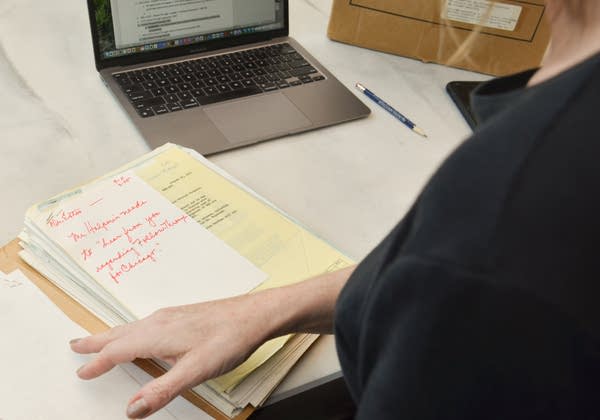
In the late 1970s, Susie Andrist was on the precipice of changing the world.
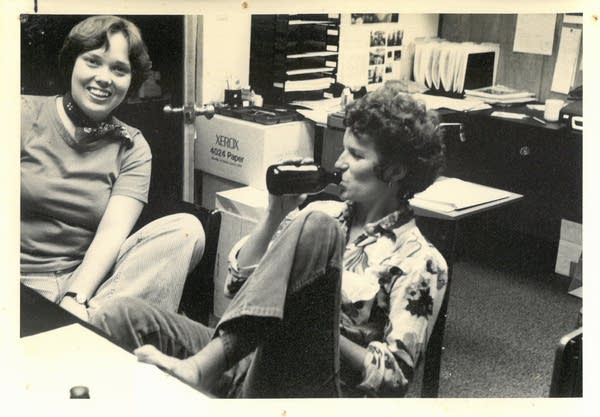
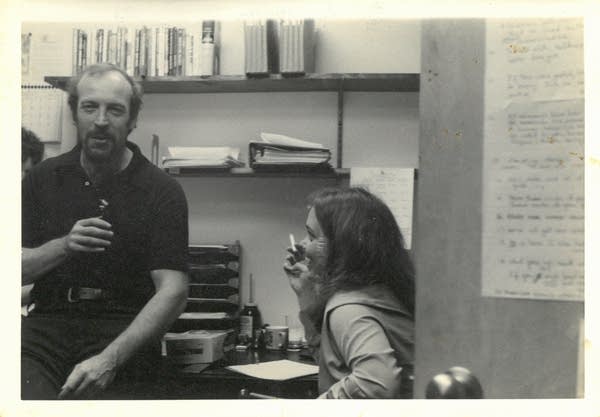
At least that’s what she thought. She and her colleagues had spent a decade traveling all over the United States teaching disadvantaged kids in elementary schools. They flew in small, alarmingly bouncy planes. They drove old, unreliable cars.
Places such as Flippin, Arkansas, and Rosebud, South Dakota, became their second homes.
In North Carolina and Rhode Island, they encountered cranky superintendents. In Mississippi, they encountered the Ku Klux Klan.
They were out to prove a brand-new teaching method. The program, which had been criticized by the press and the educational elite, was participating in a grand federal experiment.
The experiment was called Project Follow Through. It remains one of the largest educational studies in history.
The federal government spent hundreds of millions of dollars trying to answer a question: What works to help disadvantaged kids catch up to their peers?
The study did provide some answers. But it didn’t change education, or resolve debates about how to best teach America’s children — especially those who have fallen behind. And that still breaks Andrist’s heart.
“It’s just astonishing to me that we’re still fighting the same battles,” she said.
A chance to find out what works
Over nearly a decade, Project Follow Through tested 22 educational programs for children in kindergarten through third grade.
Meeting notes from the project convey a sense of optimism that the huge federal investment would pay off because it would provide a direction for American schools. At one 1968 gathering, a government official called Follow Through “truly significant” and talked of its ability to “study and produce change.” Another participant described a desire to “change the system” and went on to say, “Many people see (Follow Through) as a mechanism for change.”
The Office of Education, a predecessor to the Department of Education, intended to disseminate successful programs across the nation.
Both government leaders and educators expected that Follow Through would positively impact students, regardless of which teaching approach was used.
After a decade of tireless work and massive federal spending, the study found the vast majority of the educational programs failed to improve student outcomes, or even had negative effects. Except for one. It was called Direct Instruction.
But driven by the voices of disgruntled program developers, an influential foundation set out to discredit the report.
It worked. The Follow Through study did not change American schools. In fact, the government abandoned its plan to promote the educational programs that had proven most effective.
Today, schools that use the winning program tend to use it only with students who are struggling academically. But for a brief moment 50 years ago, it was poised to change education, offering a solution to teaching the poorest kids in America — and in fact, to teaching all kids.
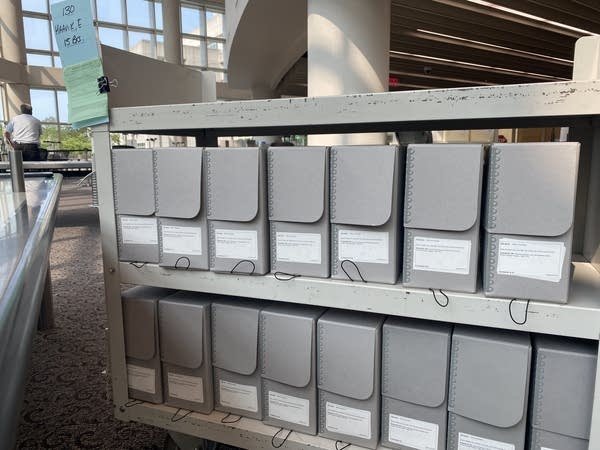
The history of Follow Through is buried in the National Archives. APM Reports examined 34 boxes of original government documents, and tracked down and interviewed 20 people who were involved with the project. The reporting revealed a complex story of politics and professional rivalry:
There was a clear winner. Evaluators hired by the federal government found Direct Instruction was the most successful program.
The Ford Foundation, which had financially supported some of the unsuccessful programs, commissioned a report that challenged the results of the entire study. In an interview, the lead author of that report took credit for the government’s decision not to back Direct Instruction.
Instead, the government started giving more money to the Follow Through programs that had not done well. The rationale was that those programs needed more time to prove themselves.
Multiple people who worked on Follow Through said they still believe the nation missed something by disregarding the results.
Internal government documents show the Office of Education feared the public would judge Follow Through too harshly and thus sought to control the narrative by withholding data or delaying its release.
Evaluators caved to influential educators’ demands for anonymity, destroying the ability to reanalyze the data using modern methodological tools.
A confusing conception
In 1967, President Lyndon B. Johnson announced an effort to help poor children catch up to their more privileged peers in school. The new initiative would “follow through” on Johnson’s preschool program, Head Start.
“We must make special efforts to overcome the handicap of poverty by more individual attention, by creative courses, by more teachers trained in child development,” Johnson said in a message to Congress. “This will not be easy.”
And it wasn’t.
The mounting costs of the Vietnam War were squeezing the federal budget. Just two months before Follow Through was approved, Congress slashed its funding by more than 80%. Project organizers scrambled to keep it alive.
Instead of a full-scale service program like Head Start, Follow Through was reimagined as a research project.
The Office of Education chose 22 instructional programs to launch pilots in schools all over the country. They were supposed to represent the nation’s most innovative approaches to education.
“For the first time, research institutions, universities, others with theoretical and experimental ideas about education of children, were asked to take their ideas from the college classroom, from textbooks or from laboratory school, and put them into practice in the public schools,” said one of the Follow Through evaluators, Bob St. Pierre, in an interview.
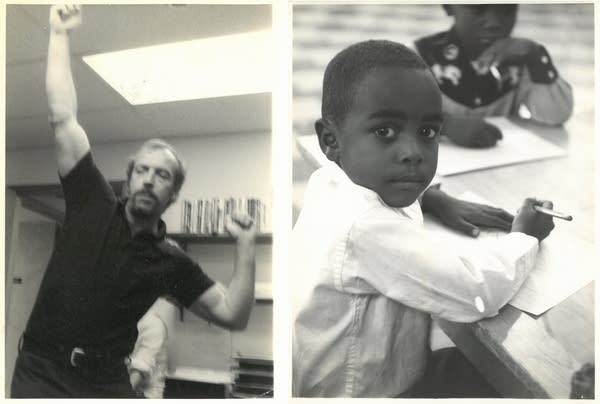
Direct Instruction was a relative newcomer among the competing programs. Another contender, Bank Street College of Education, was a revered graduate school in Manhattan. Established in 1916, it had already helped the government launch Head Start.
Follow Through officials relied heavily on education insiders from the earliest stages of the project. Bank Street’s dean, Gordon Klopf, led the first advisory committee. The Ford Foundation, which would go on to fund Bank Street and several other Follow Through program developers, helped choose which educational programs would be tested.
Powerful forces were already at work, and they would shape the interpretation of results for the public. The data that was intended to solve the mystery of what helps disadvantaged kids learn would end up challenged, obfuscated, and eventually, irretrievable.
What’s the goal?
A look through thousands of pages of internal Follow Through documents preserved at the National Archives revealed a state of turmoil.
From the first massive budget cut, the project was fighting for its own survival. Money was a continual source of stress. So, too, was the fear that the government’s investment would be viewed as a waste.
John Evans with the Office of Education cheekily called Follow Through “an acrimonious and unresolved series of arguments” among everyone with a vested interest, from administrators to Congress.
Follow Through was thrown together hastily. Organizers were racing to get programs into schools by the fall of 1968. One government memo stated, “This program was developed on a ‘crash’ basis with insufficient staff, many of whom had no previous government experience.”
Educational program developers and government organizers had trouble coming to terms about what, in fact, they were supposed to be measuring. The programs had varying goals and philosophies.
A small minority, which included Direct Instruction, were highly structured and academic. They were grouped as programs focused on basic skills.
The other programs were wide-ranging, but underlying many of them was a belief that children should discover knowledge through their own experiences — a theory based on the work of developmental psychologist Jean Piaget and educational philosopher John Dewey. Those included Bank Street and another prominent program, Michigan-based High/Scope, both of which are still active today.
The discovery-based programs had more abstract goals such as improving self-esteem and social skills. They repeatedly complained about the tools used to measure their success. It may be easy to test kids on reading or math, they argued, but how could one tell if their confidence improved?
At a meeting in 1968, the notes document one program developer saying he was “bothered by the fact we are trying to do unconventional things but evaluating them in a conventional way.” And one report stated that, as early as 1969, some of the developers felt “the cards were stacked” in favor of the basic skills programs.
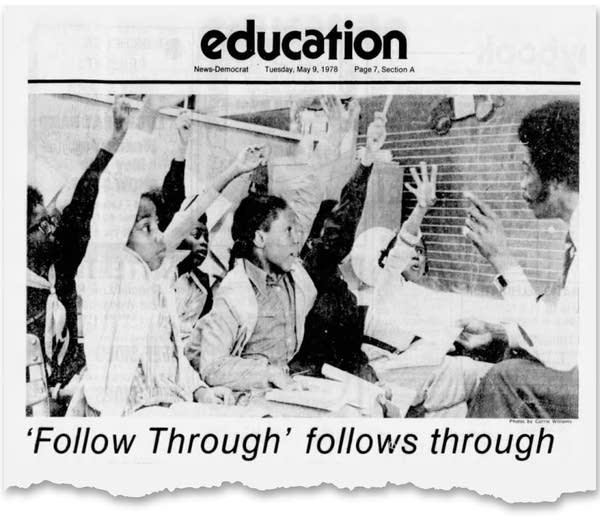
As the discontent mounted, Follow Through expanded. At its peak in the 1971-72 school year, there were 80,000 children enrolled across nearly 180 communities.
A lack of transparency
The government contracted Stanford Research Institute (SRI) to gather data from schools and see if students were improving.
But once SRI reviewed that first year of data, 1968-69, the Office of Education decided to withhold it from the public. They did the same with the data from the next school year.
Internal meeting notes show that officials and developers agreed programs shouldn't be judged while they were getting up and running. Follow Through Director Robert Egbert wrote in a letter to project coordinators that releasing data prematurely could be “seriously misleading.”
It is not surprising that government leaders withheld the first-year results. APM Reports found a copy of that draft report buried in the National Archives in College Park, Maryland. It showed that students enrolled in Follow Through programs were performing inconsistently and sometimes even worse than kids who weren’t involved at all.
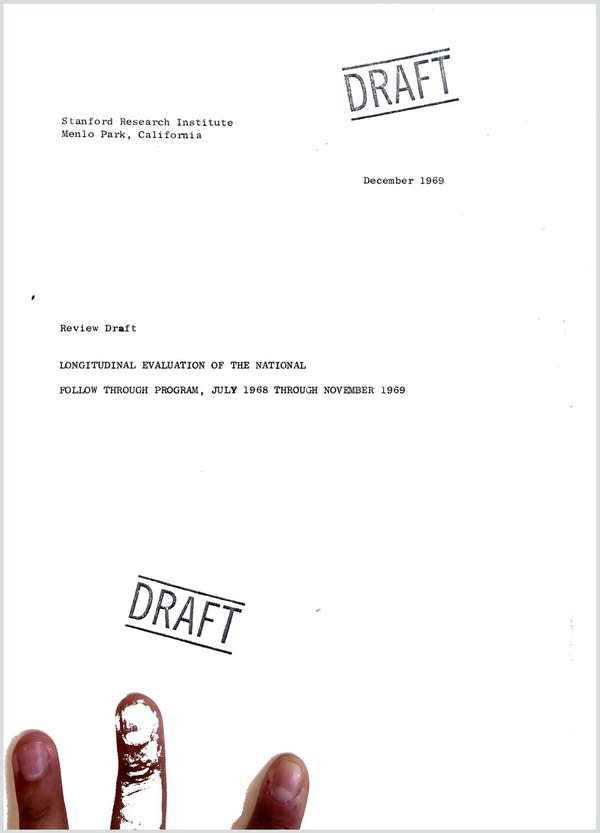
SRI wrote in a summary of the report that “there definitely seems to be some overall tendency” for kids in Follow Through to do better than other children “in certain variables.” They went on to write, “In others the tendency is not so great.”
One Follow Through staffer who was quoted anonymously in a 1976 history of the project said, “We all expected a ‘slam-bang’ effect that would give the program a big boost. But it just wasn’t there.”
W. Ray Rhine, who worked on the SRI evaluation, was later quoted as saying, “there were deliberate efforts made to restrict the amount of information.”
The reluctance to share data didn’t sit well with educators at the schools participating in the project. The New York City Board of Education wrote increasingly irate letters to Follow Through’s leadership. By 1971, some program developers and communities were pushing so hard for data that Follow Through began releasing it.
Meanwhile, another disagreement simmered. Meeting notes document ongoing concerns about comparing the educational programs, otherwise known as models, to one another. Even the evaluators were hesitant to make direct comparisons. But over the years, a few key Follow Through leaders charged forward in their efforts to find a winner.
Evans, who led Follow Through for the Office of Education, called the project a “horse race” and argued “it is mushy policy to say that all models made a fine effort, so ‘take your choice.’” Another Follow Through director, Garry McDaniels, wrote that “one of the greatest potential attractions of Follow Through” was the opportunity to rank the different educational models.
The results are in
The Office of Education hired a firm called Abt Associates to analyze the data SRI had been collecting. In 1977, Abt published what everyone had been waiting for: the final evaluation of Project Follow Through.
The results for most programs were unimpressive. Abt Associates author Richard B. Anderson said in an interview with APM Reports that his team had the unenviable job of “disappointing the crud out of” the program developers who had hoped to make a positive impact.
Many programs, including Bank Street and High/Scope, had neutral or even negative effects on student achievement. The Abt Associates team noted in its report, “Apparently, it is genuinely hard to raise the test scores of disadvantaged children.”
Even so, in the charts and graphs that Abt Associates published, one program continually rose to the top. It had “substantially higher average effects” and was the only “notable exception” to a trend of programs showing more negative than positive effects on basic skills test scores. It was Direct Instruction.
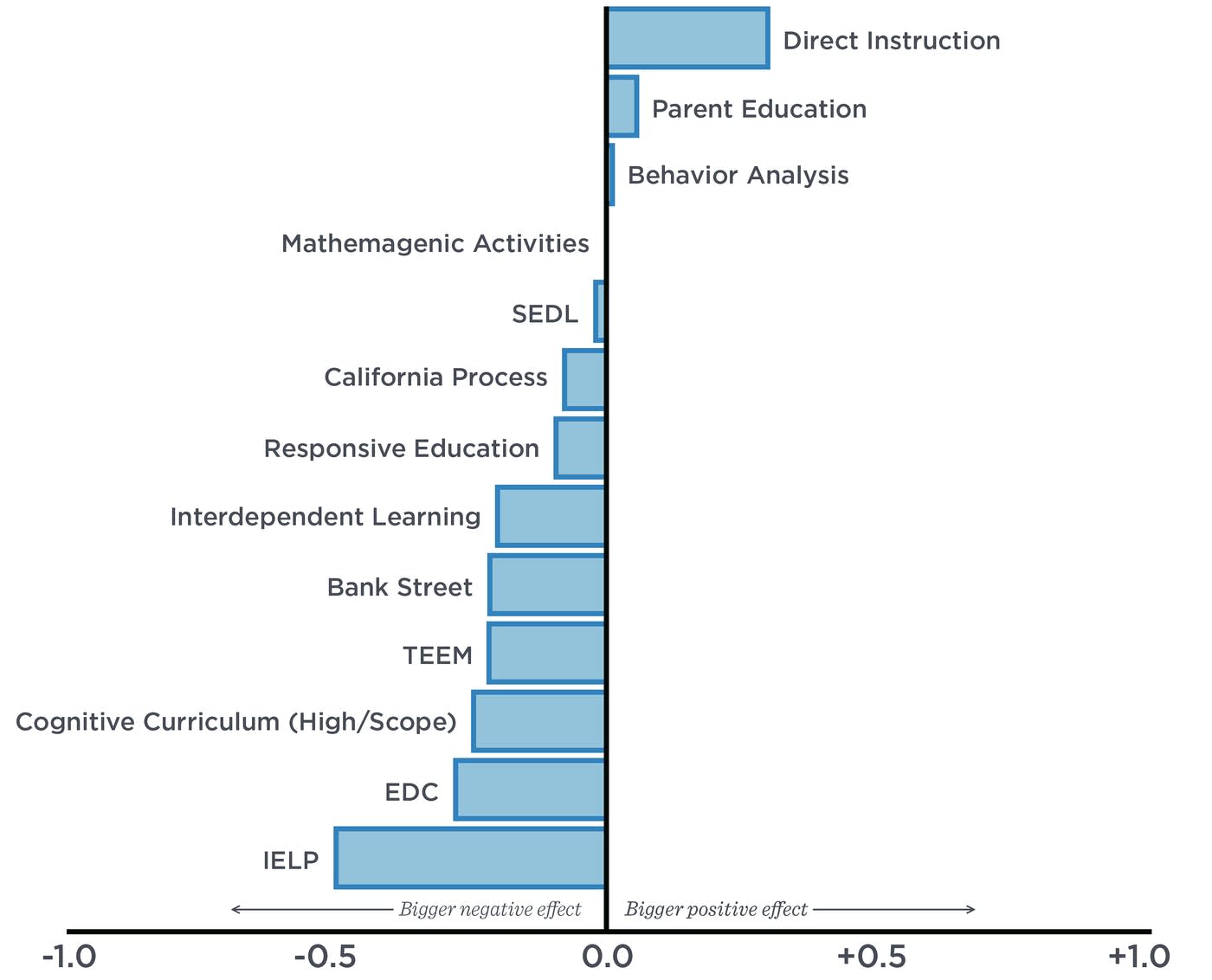
Direct Instruction excelled not only in basic skills, but also in the problem-solving domain.
Most surprisingly, Direct Instruction beat all the other programs in “attitudes toward learning” and self-concept — areas in which other program leaders expected to excel.
Abt Associates drew the conclusion that, in general, the “basic skills” programs were the most effective.
These findings were scattered throughout the 277-page behemoth of a final evaluation. Anderson called it the last in a series of “enormous unreadable reports.”
Because the findings were so dense, it was largely up to the press, the government, and other experts in the world of academia and evaluation to interpret them.
A newspaper columnist for the Washington Star summarized the report like this: “Basics are better.”
But that’s not the only interpretation that gained traction.
Results under fire
Follow Through’s results showed that, after hundreds of millions of dollars in funding, nearly every program had failed to produce academic gains. The Office of Education was not pleased.
“Government people did not like what we found, because it wasn’t what Follow Through was supposed to do,” Anderson recalled in an interview.
Most of the program developers felt they were being evaluated unfairly — and some had a relationship with one of the nation’s largest philanthropic organizations.
The Ford Foundation had financially supported several of the program developers for years, and would go on to support more of them. Marjorie Martus, who worked for the foundation, even helped select the programs that participated in Follow Through.
After the disastrous final report, Martus called an evaluation expert, Ernest House. She asked him to see if there was anything to the complaints.
House met with the program developers in Michigan, where they were hosted at a rural camp by the creator of the High/Scope program. There, the developers explained their frustrations. They felt the evaluation was too narrow to capture their programs’ more abstract goals. Evaluators had intended to establish new tools to measure these goals — but had never delivered.
“I decided they had a reasonable complaint about what they had been promised,” House said in an interview with APM Reports.
The Ford Foundation then hired House to convene a panel of experts and reanalyze the Follow Through data. In 1978, less than a year after the government’s final report came out, the panel published a rebuttal.
The panel pointed out that no single program was successful everywhere it was tried — even Direct Instruction. This, House and his panel wrote, was the primary finding of Follow Through: Nothing works everywhere.
There were already well-known issues with the project’s experimental design. The sites were not selected randomly, and neither were the control groups. The study lost a lot of students over time. Abt Associates had acknowledged all these problems in their final report, adding caveats to the findings.
But House’s panel went further, saying the quality of the data was insufficient to compare programs, let alone declare winners.
“The Department of Ed wanted to say this is the best reading program, the best early childhood education program, and presumably, other people should adopt this program,” House said. “We said there’s no simple answer here.”
House now believes his report convinced the government to switch strategies.
“Our critique was very effective in stopping the government from saying Direct Instruction … that’s the way to go,” he said. “I explained to them ... that the programs have different effects in different settings. And it’s very difficult to say one program is going to fit the entire country.”
It’s not clear which program developers requested the Ford Foundation’s intervention, prompting the damning critique. House said that many people called Martus, and when he met the developers in person, everyone except the representatives of Direct Instruction complained. House said “by far the most outspoken” was David Weikart, host of the retreat and creator of High/Scope. Documents obtained by APM Reports revealed that Weikart also wrote to Martus to thank her, predicting the rebuttal would be a “best seller.”
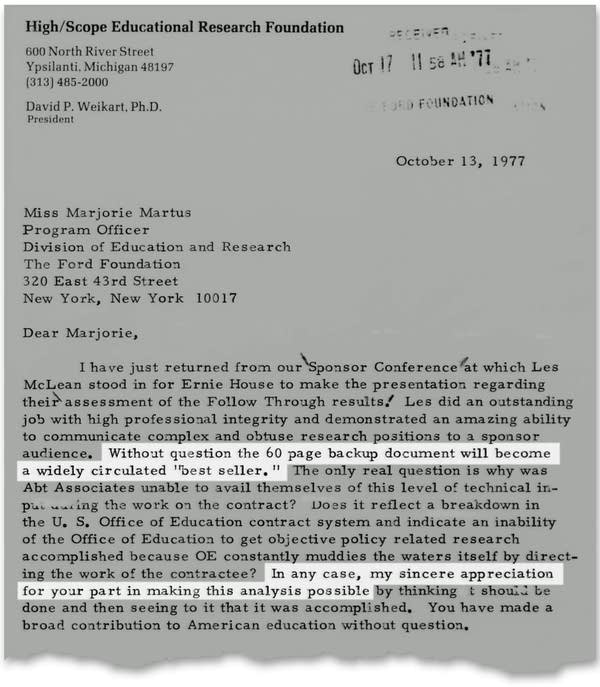
Martus died in 2001. The Ford Foundation did not want to comment for this story.
House said he has no dislike of Direct Instruction. Another member of his panel, though, expressed sharp criticism of the program.
Gene Glass is a well-known figure in academic evaluation and a former president of the American Educational Research Association. Glass disliked Direct Instruction long before he joined House’s panel. He told APM Reports that he watched about 10 minutes of a Direct Instruction lesson in the 1960s. He thought it was “unimpressive” and even seemed to “torment” children.
In the areas where his panel could not refute Direct Instruction’s success, such as its language scores, he believes it simply teaches to the test.
“I grant them nothing, nothing,” Glass said in an interview with APM Reports. “I find no evidence in the entire Follow Through evaluation that they have anything special or worthy of wide distribution.”
But two researchers who worked on Follow Through 50 years ago said in interviews that they remain convinced that Direct Instruction was shown to be the most effective program.
“If you look at averages, then on average, Direct Instruction is doing better than other projects,” said Bob St. Pierre, one of the Abt Associates evaluators.
“I think a lot of people have biases that make them not want to accept it,” said Andrew Porter, who worked as a research adviser to the Follow Through project in his role at Michigan State University. “Direct Instruction just doesn’t square with the beliefs and values of a lot of teacher educators.”
Fighting back
When the government’s ambivalence about the final results became clear, the leaders of Direct Instruction took action. Zig Engelmann and co-director Wesley Becker sent their complaints (peppered with language such as “sham” and “travesty”) to top education officials.
Rosemary Wilson, the director of Follow Through at that time, wrote back, echoing House and Glass: “No single instructional approach, including that of Direct Instruction, was found to be consistently effective in all of the projects where it was tried and evaluated.” Wilson was correct. Although Direct Instruction had positive effects, on average, across the country, one analysis showed 3 of 10 sites had negative effects.
But in 1978, Engelmann and Becker's inquiries received a response from someone much more influential: Commissioner of Education Ernest Boyer, one of the highest-ranking education officials in the United States. Boyer acknowledged that Direct Instruction was the only program “found to produce positive results more consistently than any of the others.”
But since there was only one successful program, Boyer wrote that the federal government had decided to pivot.
Even unsuccessful programs worked well in at least one location. So the government would promote successful sites instead of successful programs.
A 1979 federal guide catalogued around 250 of these government-endorsed, “exemplary” educational program sites. Only three of them used Direct Instruction.
A few years later, in 1982, Direct Instruction was dealt another blow. The Department of Education gave even more money to unsuccessful programs, in the hopes that those programs could improve. Education officials believed this would provide public schools with something that was, and still is, central to American education — more options.
This strategy also allowed the Department of Education to support popular programs that championed children’s experiences and individuality, instead of claiming that one structured approach could work best for all kids.
Looking back, Andrist said she remembers how she felt when she and her team realized the federal government was not going to spread Direct Instruction across the nation.
Andrist said other program leaders experienced rage. She felt grief.
“Just thinking about so many kids’ lives who could be dramatically different than what they’re going to be,” she said. “That is probably the heartbreak of my career.”
Re-examining Project Follow Through
For those who wished to disregard the Follow Through results, the study’s design flaws made it easier to do so.
In 2026, researcher Jean Stockard thought she had found a way to change that. She discovered that the raw Follow Through data was available online. She hoped it would give her a chance to take a fresh look at the study’s findings.
“The Follow Through data is an amazing dataset,” she said.
She spent weeks converting and cleaning the decades-old files. Then, she made an unpleasant discovery. The data had been intentionally scrambled — largely at the request of the program developers.
SRI explained the decision in an accompanying document by saying, “concern has been expressed, particularly by Follow Through (program developers), that not only child and school-level confidentiality be maintained, but also project confidentiality.”
At the request of those powerful voices in education, SRI agreed to anonymize the data. Stockard believes an error occurred in the process that made it impossible to relink the programs to their results. Today, she said, the data is basically useless.
“A real disappointment and a real loss to the profession,” Stockard said.

Another researcher, Stanford education and economics professor Thomas Dee, hoped to use modern techniques to account for the problems with Follow Through’s experimental design and try to verify its results.
“To have run this large-scale experiment and not be in a position to take away lessons from it is such a waste of our resources and effort,” Dee said.

