Direct Instruction is controversial — but not among teachers who use it
Direct Instruction programs have long drawn criticism from educators who say they limit teacher autonomy. But surveys suggest that teachers who use the programs tend to view Direct Instruction favorably — especially when they receive training and ongoing support.

Direct Instruction has a bad rap. If educators have heard of it, chances are they’ve heard more criticism than praise. Yet Direct Instruction, a suite of programs for teaching reading, math and other subjects, is also among the most studied and most effective in education.
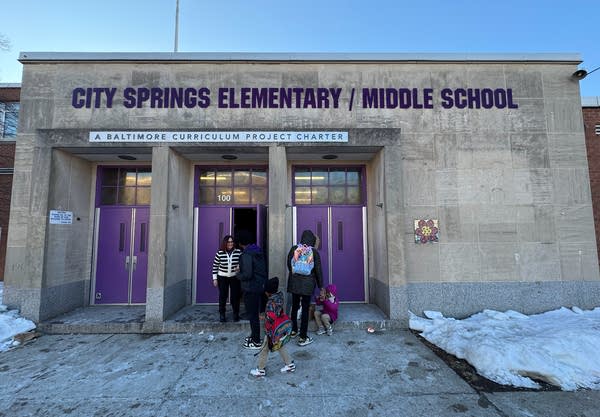
For Rhonda Richetta, a principal in Baltimore, that controversy has been a recruiting challenge. Her school, City Springs, has used Direct Instruction programs for more than two decades. A local university has told her it won’t send student teachers to her school because of it.
Critics, including many professors at schools of education, have long argued against using Direct Instruction, describing its programs as regimented and even authoritarian. They argue that the tightly prescribed lessons constrain teachers and leave little room for creativity.
But an APM Reports review of available survey data shows that teachers who use Direct Instruction tend to like it.
The data is limited, often collected for graduate school dissertations, but teachers generally report positive experiences with Direct Instruction, particularly when they receive initial training and ongoing coaching. Some skeptics even become supporters after seeing how the lessons work with their own students. One survey showed Direct Instruction teachers are more likely than their peers to believe that all children can learn.
In a 2025 survey conducted by the RAND Corporation, just 2% of teachers using Direct Instruction’s math program viewed it negatively — the lowest rate of dissatisfaction among all the elementary math programs surveyed. (RAND didn’t ask teachers how they felt about Direct Instruction’s reading programs.)
SOURCE: RAND’s American Instructional Resources Survey (Spring 2025)
Jade Livers, a fifth grade teacher at City Springs, said she’s heard critiques that Direct Instruction sounds “robotic.” But “if people came and visited, saw how it works, I think people would be more open to it,” she said. “People are afraid of the unknown. If it doesn’t look like what they’re familiar with, it’s like, ‘I don’t want to do that.’”
‘Tell us what to say’
The most controversial aspect of Direct Instruction is its use of scripts, which provide teachers with specific language and examples to use in each lesson. The goal is to make the most of limited instructional time while giving students a consistent routine.
Kelli Popper, a teacher who uses Direct Instruction in international schools, said the lessons are scripted “to minimize the amount of confusion and talk that happens when you’re teaching.” The idea is to cut down on unnecessary explanations that can confuse students or distract from the lesson.
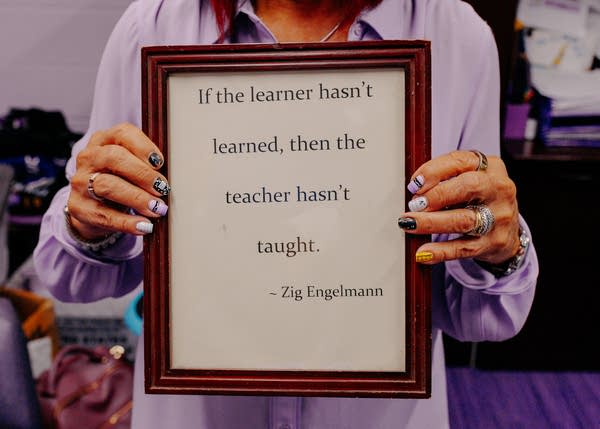
Direct Instruction’s founder, Siegfried “Zig” Engelmann, and his colleagues started scripting lessons as they developed the programs in the 1960s. Engelmann found that teachers weren’t always clear and concise when introducing new concepts, and efforts to address that problem through coaching had been unsuccessful.
“Teachers would tell us, ‘Don’t tell us what to do. Tell us what to say,’” said Elaine Bruner, one of the first teachers to work with Engelmann. “That’s where we came up with scripts.”
The program developers were trying to make the lessons as precise as possible, a goal that would later be referred to as “faultless communication.” Engelmann didn’t want to waste time correcting the misunderstandings that can result from confusing, improvised explanations. The team tested the scripts in classrooms and revised them until they were unambiguous.
In a Direct Instruction lesson, the teacher asks a series of rapid-fire questions. “Get ready,” the teacher says, then pauses and claps or snaps to signal students to answer. The class responds in unison, or the teacher calls on individual students by name. The fast-paced, game show-like rhythm is designed to keep students engaged, minimizing opportunities for their attention to wander.
For better or worse, scripts are “teacher-proof, in a way,” said Geoffrey Borman, a University of Arizona professor who studies the effectiveness of educational programs. With a script, the quality of instruction is more consistent. Some teachers may deliver the lessons more effectively than others, but all have a common foundation to work from.
While the scripts outline much of what teachers say during lessons, they don’t prevent teachers from responding to students, offering additional explanations or using their own words when needed. Engelmann described them as a “template” experienced teachers could build on.
Doug Carnine, who worked with Engelmann on the development of Direct Instruction, compared the scripts to sheet music. Just as an orchestra conductor internalizes a musical score, teachers can internalize the scripts. The established routine allows teachers to focus on delivery, watching for signs of confusion and giving students additional turns to practice.
“The purpose of these scripts is you shift your focus to the kids,” Carnine said.
Popper said that she’s been teaching Direct Instruction so long, an observer likely wouldn’t be able to tell she was using a script. “You can see the flow in my room, and it’s magic,” she said. “It sounds like music in here with all voices on signal (and the) choral responses. Everybody knows what to do.”
Willing to give it a try?
At City Springs in Baltimore, Richetta said she’s had to look hard to find teachers open to Direct Instruction. She’s encouraged classroom aides to earn their teaching credentials, and she even convinced a technician at her nail salon to consider a career in teaching.

Richetta had to warm to the program herself. She’d been teaching for 12 years when she first encountered Direct Instruction in the late 1990s.
“I was just a traditional teacher,” Richetta said. “I’d never had to read a script.” At one point during the two-week training, she called Bernice Whelchel, the principal who had recruited her to City Springs, and asked, “What have you got me into?”
Her perspective began to change once she started using the lessons. She said she was “very surprised” at how responsive her students were. “That was the thing that made me say, ‘Hmm, maybe I should really try to get better at this.’”
Soon, her students were learning “at a pace that I had not experienced in my teaching career,” Richetta recalled. The results made her look back with regret on her earlier years of teaching. She realized she’d made excuses for why some students weren’t learning.
“I almost wanted to find them and apologize and say, ‘I’m sorry. It wasn’t you. It was me.’” Richetta said. Whelchel reassured Richetta. “It wasn’t you,” she said. “You didn’t have the right tools, and now you do.”
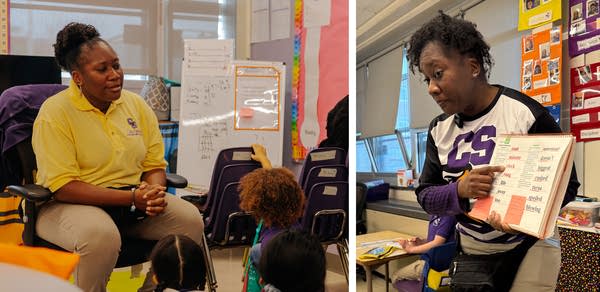
Now Richetta is the one recruiting teachers, just as Whelchel once recruited her. At City Springs, newer teachers said the scripts were particularly helpful as they learned how to teach. Rather than having to figure out how to sequence a year’s worth of material, the lessons had “everything lined out for you,” said Livers, the fifth grade teacher Richetta met at her nail salon.
Livers worked as a tutor and aide at City Springs while earning her teaching certification. She said many of her students transferred in from other schools and still struggled with basic phonics. Realizing that some of her 10-year-olds could barely read was “disheartening.” But watching them make progress was motivating. “Seeing the results, that’s what encouraged me,” she said.
Despite serving predominately low-income families and students who are frequently absent, City Springs exceeded Baltimore’s citywide average for third grade reading on last year’s state test.
Support needed
Direct Instruction’s scripts are supposed to make teaching easier. But delivering a lesson well, with its quick call and response, can still be a challenge.
At an elementary school in rural West Virginia, some teachers resisted the introduction of Direct Instruction, according to a 2000 dissertation. Several teachers told a researcher that the program was being forced on them. Some found the scripted lessons “repetitious” and “stifling.” Others were frustrated by changes to the school schedule. After a year, teachers reported seeing little improvement in student learning. Of 17 teachers who implemented it, nine reported “serious concerns” about Direct Instruction and another four refused to use it for a second year.
The experiences of educators at City Springs show what it takes to make Direct Instruction succeed in a school.
“Sometimes people say that they tried (Direct Instruction) and it didn’t work,” Richetta said. “I think that might be because teachers were not provided the training that is necessary in order for it to work.”

Livers remembered her own challenges learning to teach it. “Snap, clap, all this,” she said. “You’re like, ‘What?’” Instructional coaches demonstrated the techniques and helped her find a rhythm. Soon, the lessons felt “seamless,” she recalled.
These days, Livers is putting her own spin on the scripts, giving the students more opportunities to respond and talk to each other. She’s also bringing more of her personality — her “extraness,” as she calls it — into the lessons, while keeping the underlying structure intact.
“I was almost wondering,” Livers said, “How do you teach without a script?”
Additional reporting by Emily Hanford, Emily Haavik and Kate Martin.

