Direct Instruction is good for students. Schools rarely stick with it
Decades of research support the effectiveness of Direct Instruction, a highly structured teaching method and set of scripted programs. But many schools that start the program end up dropping it.

Donna Dwiggins drove around Guam in a pickup truck, stopping at schools all over the island. She was retrieving books from a discarded curriculum, something the school district had mandated just a handful of years earlier. Dwiggins had moved to the island to support the rollout of the program. Then it all fell apart.
Guam’s Department of Education had received a federal grant to bring Direct Instruction, an effective but controversial method of teaching, to nearly all its elementary schools. The process was contentious from the start, Dwiggins recalled.
“Most of the time you’re going into politically hot situations, because they have failed,” Dwiggins said. “The people from the district holding on by their fingernails to their jobs are really offended because you’ve been brought in to fix the problem that they created.”
For decades, Dwiggins worked with Direct Instruction in classrooms across the United States and its territories. She says she has worked with it in hundreds of schools, but few of them are still using it. Despite a mountain of research on its effectiveness, many schools eventually give up on Direct Instruction. APM Reports wanted to understand why.
We contacted more than a hundred schools and districts that have used Direct Instruction at some point since its inception in the 1960s. We talked to people who used it in small, rural schools and large, urban districts. People told us about why they started the program and why they stopped.
Some patterns emerged:
Administrators often bring Direct Instruction in as a last-ditch effort when other things haven’t worked. That’s a challenging place to begin.
Schoolwide implementation of Direct Instruction often requires big changes to assessment, data collection, student grouping and school schedules. Making those changes can be complicated, especially in schools where staff are already stretched thin.
Many teachers have an initial distaste for the program because it uses scripted lessons. It can take clear messaging and training, accompanied by ongoing coaching, to convince teachers.
If the principal, curriculum director or superintendent who launches the program leaves, it loses its champion. Leadership turnover is common in American schools.
Grant money is often used to roll out Direct Instruction. When those funds dry up, it can be difficult to sustain the program.
Many of these problems are not unique to Direct Instruction. Any new education program is more likely to succeed with a strong leader, sustained funding and support for teachers. That’s according to implementation science, a growing field in which researchers study how to effectively put new systems into practice.
But Direct Instruction is often a bigger transition for schools than a new textbook or curriculum. “The workforce that comes in has to be reeducated,” said Doug Carnine, one of the program’s developers. “And the principals have to be reeducated, or you have to find ones that are supportive. And you have to have the money for the intensity (of the program).”
‘Hot situations’
On Guam, the public school system had planned to mandate use of the Direct Instruction curriculum for five years, starting in elementary grades and moving into middle schools as students aged. Broadly, Guamanian students were in bad shape. On average, 4 out of 5 third graders were behind in reading. In fifth grade, nearly 9 out of 10 students were behind.
The superintendent who was in charge when the Guam schools first rolled out the program was supportive. The district had a federal grant and guidance from Dwiggins and her team, who were there on behalf of the National Institute for Direct Instruction, an organization that provides training and coaching to schools using the program.
Test scores improved in the schools that used Direct Instruction. But not everyone loved the structure and intensity of it.
In 2004, a year after the district started putting Direct Instruction in place, the Pacific Daily News published an op-ed by Guam-based educator Robert Underwood. He wrote that an approach like Direct Instruction “robs (teachers of their) autonomy, debases the profession and doesn’t contribute to our children’s education.”
The program was unpopular with factions of the school board, too. There was churn in leadership. The district had four superintendents and two interim superintendents in just five years. The district struggled to keep up with the federal requirements to keep the grant money coming.
By the end of the first five years, district politics, educator distaste and funding swings finally came to a head: The superintendent at that time decided Direct Instruction would be optional for elementary schools. Fewer than half chose to continue with it. Dwiggins and her team were let go months before the end of the second five-year contract they had signed with the district, she said.
But Dwiggins stayed on Guam.
She drove around, collecting old Direct Instruction books from schools that had stopped using them and redistributing many to the schools that had stuck with it. And she kept some of the books and used them a couple years later to help launch a charter school on the island.
“Had (Direct Instruction) stayed in the mainstream, in the regular school district, there would’ve been no need for (a charter school),” Dwiggins said.
Charter schools can offer a different path for sustaining Direct Instruction. While they face many of the same obstacles as traditional public schools, they operate independently from many state and local regulations. Charters have to apply for their status and are required to outline a concrete goal for their operations. They tend to gravitate more toward a school or network-wide curriculum to meet these goals. These qualities can bolster Direct Instruction’s durability.
‘It’s obviously not going well here’
Hailey McCarthy was the new principal at a Texas charter school when she first took on a Direct Instruction implementation on her own. The network’s administrators were rolling out Direct Instruction across its campuses.
McCarthy’s school was new, and it had been struggling to get the program off the ground. Teachers weren’t understanding. She didn’t know what to tell them.
“I took over and I was like, OK, I have to learn about this because it’s obviously not going well here,” McCarthy said.
She remembers that the sheer amount of student performance data she had to review was overwhelming, something like 500 pages every week. The program coaches spoke too quickly in weekly meetings to review the data, she said. She left unsure of how to use everything that had been collected to help place students in the right classes or advise teachers on which lesson to teach.
“I’m messing up,” McCarthy remembered saying to someone from the National Institute for Direct Instruction, which was working with her network to get the program started. “I am so sorry. It is not that I’m resistant. It may come across that way. I legitimately have no idea what I’m doing.”
She asked for more support.
The institute sent McCarthy new coaches, and she started teaching the program herself to understand it. She read about it. She immersed herself in it. And she started to see it work.
A few years after she arrived on campus, her school led the charter network for students at or above grade level.
Now, McCarthy is superintendent at another network, BridgePrep Academy Charter Schools in Florida, where she is leading adoption of Direct Instruction across 25 schools in the state. She believes that the program a school chooses matters, and she believes in Direct Instruction — but she believes even more in the importance of implementation.
“If the books are on the shelf and never get used, who cares?” she said. “Why even buy them?”
Two weeks to see progress
Schools rarely implement programs with true fidelity, said Andrea Boden, who runs a consulting group that supports schools in getting the most out of their curriculum.
Boden spearheaded a successful adoption of Direct Instruction in Gering, Nebraska, in the early 2000s. The district’s Hispanic students were trailing far behind their white classmates, and there was a similar gap between students from lower-income families and more affluent ones. The Gering leadership team went all in on Direct Instruction.
“I think we just accidentally did a lot of the things in implementation science,” Boden said.
School leaders learned the program by teaching it themselves. Coaches reviewed data weekly and adjusted how students were grouped based on how they were performing. It took just two weeks for Boden to notice that students were making gains. By November, kindergartners were reading full pages of text without pictures.
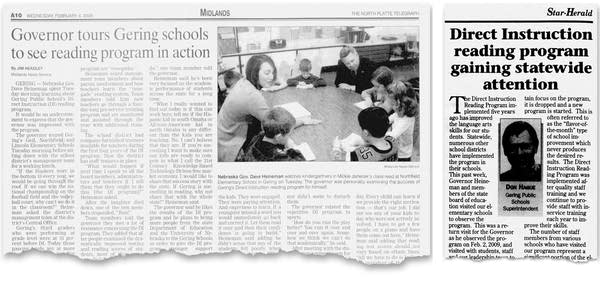
After a few years of Direct Instruction, the achievement gaps narrowed substantially.
Even so, the program faced criticism from prominent education groups. A 2009 write-up in the Omaha World-Herald documented the president of the Nebraska State Education Association calling Direct Instruction “counterproductive” and the president of the Nebraska State Reading Association describing it as “robotic.”
The program lasted in Gering for nearly a decade. It started to lose momentum as the core leadership team retired or left the district and budgets got tighter, said Jadie Beam, who worked as an instructional coach at Gering during those years.
“We didn’t have funding for full-time reading coaches,” she said. “The year I left, there were three of us, and we had to reapply for our jobs because there was only funding for two.”
Fewer coaches meant a heavier load on those who remained. That watered down the program’s precision, and Gering’s state test scores stopped improving, Beam recalled. It seemed to some like the power of the program had faded, she said.
Around 2013, Gering started transitioning away from Direct Instruction for most students, opting to use it only in special education classrooms and as an intervention for students struggling academically.
Direct Instruction can often be found in special education classrooms after a school has tried implementing it for all students and decided to move away from it. In some cases, it is brought in specifically as a special education program because it is known to be effective at helping kids improve their skills quickly. That happens so often that Direct Instruction has developed a kind of stigma as being a program only for those students — one that could be boring or unproductive for kids who are already at or above grade level. Educators who have used the program have said that’s not the case.
‘It’s working. The kids can read’
Our reporting found that Direct Instruction often faces skepticism in schools. Some teachers see it as too simplistic or rote. Others find that it challenges their long-held beliefs about what teaching and learning should look like. And implementing it takes a lot of work. But those reservations often fade once teachers see the program’s effectiveness firsthand.
“The first year I was forcing it,” said McCarthy, the Florida charter network chief of schools. “And then at the end of the first year, a couple people came to me like, ‘It’s working. The kids can read.’ I love that.”
At her current network, McCarthy rolled back data analysis to once every two weeks instead of once every week, to ease the workload on her coaches. She is bringing one subject in at a time to manage costs and give the teachers time to adapt.
“We have different class sizes, different locations, different student populations, different cafeteria schedules,” she said. “Everything is different at every school.” Educators can be put off by programs that are perceived as inflexible, McCarthy said.
Despite the challenges of implementing and maintaining Direct Instruction, decades of evidence show it works. For longtime advocates like Dwiggins, it’s frustrating that it isn’t more widely used.
“When you know you have the cure for something, and you see somebody dying from that disease, it’s gut-wrenching,” she said. “You could literally eradicate illiteracy and innumeracy.”

