Season 2, Episode 2: The Remedy Is Always Teaching
October 15, 2026
At an experimental preschool in Illinois, Zig Engelmann and his colleagues begin turning his ideas into a classroom teaching method. Along the way, they make a series of discoveries about effective instruction. Their mantra: “If the student hasn’t learned, the teacher hasn’t taught.”
Email us: soldastory@apmreports.org
Call us: (612) 888-7323


In 1965, Adrienne Allen was studying to be a teacher at the University of Illinois. A friend told her about a preschool near campus that was doing things that were new and different.
Adrienne Allen: And she urged me to come over there, to see it.
Adrienne went over. There was an observation room. And she watched as the teacher entered the classroom.
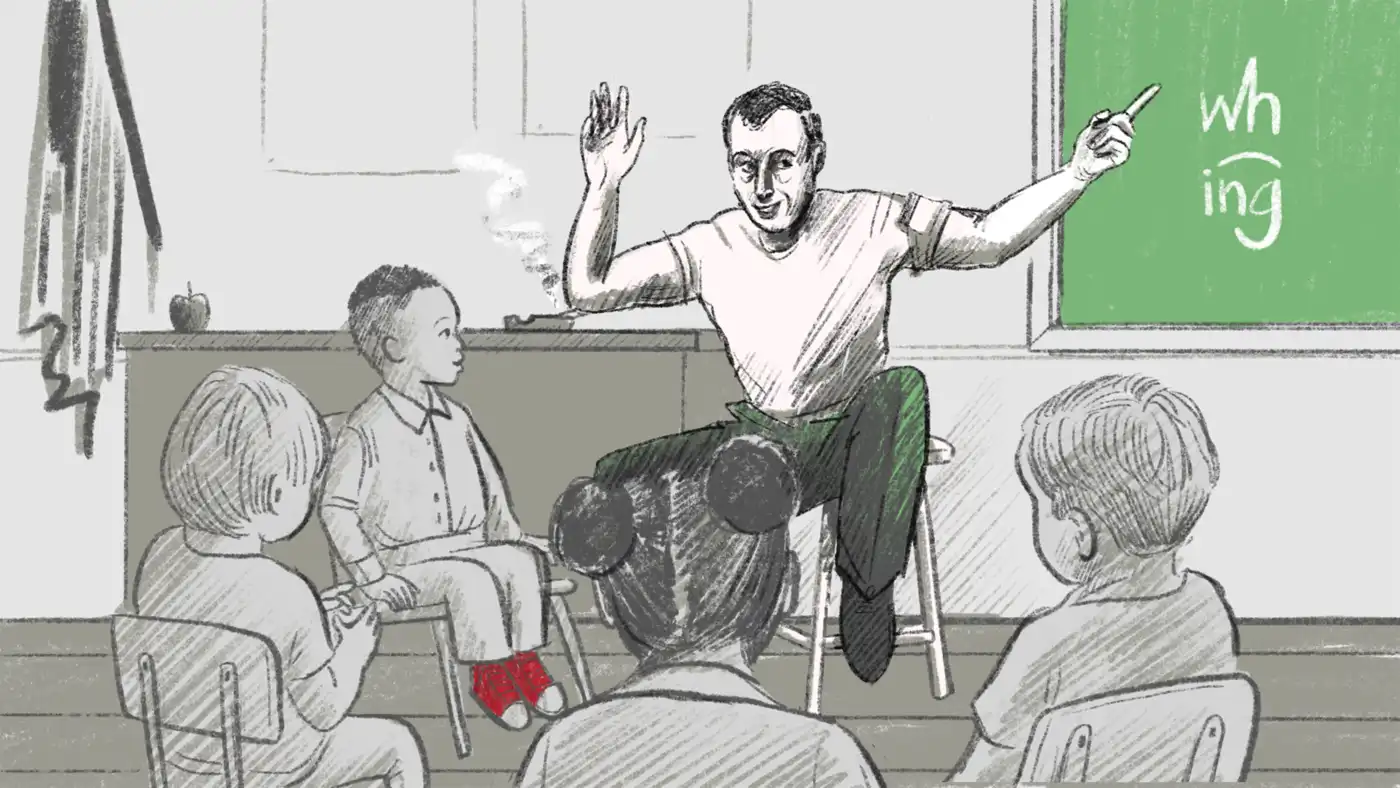
Allen: The man came in with a cigarette hanging from his mouth.
It was Zig Engelmann.
Allen: He looked like a construction guy.
He was wearing a t-shirt, the sleeves tight around his biceps.
Allen: So he comes in, the kids are happy to see him. He sits down, he takes his cigarette out and he places it upside down on the chair next to him.
Adrienne was not prepared to be impressed by a guy who would walk into a classroom of young children smoking a cigarette. But she was impressed.
Allen: He teaches them what is a hexagon and how many sides does it have, and uh, other things that four-year-olds usually don't know. And the kids were just loving it.
Elaine Bruner: I was blown away.
(Music)
This is Elaine Bruner. Everyone calls her Cookie.
Bruner: Getting a little long in the tooth for that. (Laughs)
She's 99. She also visited the preschool back in the 1960s.
Bruner: I couldn't believe what I was seeing. The kids were excited and I was excited and I thought, this is the future.
I'm Emily Hanford and this is Season 2 of Sold a Story, a podcast from APM Reports. We're at Episode 2.
In the 1960s, there was a huge amount of hope about the power of education. A belief that school could change a child's future. Especially a child from a poor family.
And preschool was the new frontier.
There were nursery schools at the time. But they were mostly for middle-class kids. And they were mostly about play.
Preschool was for a different purpose. Preschool was to prepare kids for school.
Across the country, people were starting experimental preschools. They became places to test new ideas about teaching and learning.
Zig Engelmann had an idea.
Other people had different ideas.
Different ideas about how children learn. Different ideas about how to teach them.
We're going to get to that.
First, I want to tell you about Zig Engelmann's preschool. And what he and his colleagues were learning about teaching back in the 1960s.
(Music ends)
It was the summer of 1964 when Zig and the professor he worked with at the University of Illinois decided to start a preschool.
The first thing they needed …
(Music)
… students.
They were looking for children who were the most at risk of failing. Kids who needed the most help.
So they went to the principal of an elementary school in a poor neighborhood. They asked for the younger siblings of kids who were having trouble in school.
Next, they went to the neighborhood, to meet the families. Zig remembered one home with cracks in the floor so big you could see the ground below.
The children came to preschool for just two hours a day. One hour was games, art, snack and music.
The other hour the children were divided into small groups. And they got formal lessons. Twenty minutes of math instruction. Twenty minutes of reading instruction. And twenty minutes of language instruction.
Zig said the language instruction was the most important.
Zig Engelmann: Language was the core that they lacked.
There were things the kids didn't know about language that they needed to know to be able to benefit from instruction.
(Music ends)
Bruner: We found out that they didn't understand things like ‘o-r,’ ‘or.’
This is Cookie Bruner again. She became one of the teachers at the preschool.
Bruner: So — ‘give me the pencil or the book’ and they would pick up a pencil and a book. Ooh.
You might think children don't need to be taught language. That they'll pick it up from their environment. But … environments differ.
So at the preschool, they set out to teach language in a very structured way. To make sure all the kids had a solid foundation.
Kids: This is a bottle.
Teacher: I heard everyone but you, come on.
Kid: This is a bottle.
This film from 1965 is about the language instruction at the preschool.
There are five children sitting in small chairs with a teacher in front. The teacher is also sitting in a small chair.
And she is holding up different objects — a bottle. And now a spoon.
Teacher and kids: This is a spoon.
Teacher: Let's hear you say it, Sam.
Boy: This is a poon.
Teacher: This is a spoon. Say spoon.
They're working on articulation. And speaking in full sentences.
But they're also working on something else. They're working on thinking.
The teacher picks up a cup. Asks the kids to tell her what it is .…
Teacher: What is this?
Kids and teacher: This is a cup.
But then she asks a different question.
Teacher: Is this a spoon?
The kids are looking at a cup. And being asked — is this a spoon?
Girl: It's a cup.
Teacher: I know that. Is it a spoon?
Girl: A cup!
Teacher: Is this a spoon? Alright, let's say this.
Teachers and kids: No, this is not a spoon.
Teachers: Do it. Is this a spoon? Say it .…
This probably sounds very basic to you. Maybe mechanical and kind of relentless.
(Music)
What the teacher is doing is asking the kids to think about not just — what is this? But, what is this not?
Marty Siegel: You have to understand what something is and what something isn't in order to conceptually grasp it.
This is Marty Siegel, who taught at the preschool.
He's pointing to an idea that shows up across philosophy and science and linguistics — that we don't understand things in isolation. We understand things through contrast. You know what a circle is in part because you know that it isn't a triangle or a rectangle or a hexagon.
And while it's easy for you and me to answer the question “is this a spoon?” when looking at a cup .…
Teacher: Is this a spoon?
It's not easy for a beginner.
Girl: It's a cup.
This is one of the reasons that teaching can be so difficult. You have to overcome what's known as the “curse of the expert.” Once you know something, it's hard to remember what it was like to not know. But to teach well, you have to think like a beginner.
(Music ends)
It's something Kurt Engelmann says his dad was especially good at.
Kurt Engelmann: I always say my father, more than anyone else, could get on the level of the naïve learner, the students, and see things from their standpoint. What is it that they would find difficult with this concept? What is it that they would find challenging with this skill?
Zig Engelmann was convinced that if he could identify what a child needs to know to master a skill or concept, he could design lessons to teach those skills and concepts. And any child — every child — could learn.
Zig Engelmann: They could learn it if you could sequence it properly and present it properly.
The key was the sequence and the presentation. That's what Zig and his colleagues were trying to figure out in the 1960s at their preschool.
I'm going to give you two examples of things they figured out.
(Music)
The first example has to do with fractions.
Doug Carnine: The traditional way of teaching is — a part of a pie.
This is Doug Carnine. He worked with Zig.
Doug Carnine: So, the children see maybe even a picture of a pie, and it's cut into three pieces.
They'll learn one third, two thirds. And other examples like — half a pie, a quarter of a pie.
Doug Carnine: What they learn is that a fraction is always a part of one thing.
But a fraction is not always a part of one thing. A fraction can be more than one.
Doug Carnine: You can have four thirds of pies.
He says if you introduce fractions as a part of one, and you show lots of examples where that's the case, kids are likely to learn what Zig called a “misrule.” They learn that fraction means less than one.
And they will have to unlearn that misrule later, when you introduce them to fractions that are more than one.
(Music ends)
So at the preschool, they introduced fractions that are more than one right away.
The other example of something they figured out has to do with teaching children how to read.
(Music)
Traditionally, schools introduced written letters in alphabetical order — first A and then B and then C .…
But if you teach kids written letters in alphabetical order, you end up teaching them the letter “d” almost immediately after you teach them the letter “b.”
Now think about what a lower case “d” looks like. And think about what a lower case “b” looks like. They're reverse images of each other. If a “d” looks in the mirror, it's a “b.”
That is a difficult concept for a young child to integrate into their understanding of the world. Because children spend the first few years of their lives learning that an object is the same no matter which way you position it.
Here's Zig.
Zig Engelmann: Here the kid grew up in his whole life, he never saw an object that changed its name when it changed its position.
It's actually a human survival mechanism to learn that an object doesn't change when you change its position. Cause you want to know that a lion is a lion if it's coming at you head on or about to jump on you from a tree.
But when children are introduced to written language, they have to learn a new rule: Some objects do change when you change their position. A “b” is not the same thing as a “d.”
(Music ends)
Zig and his colleagues were noticing lots of little things like this — and coming up with solutions. Like not teaching written letters in alphabetical order. So a kid really learns ‘b’ before you introduce ‘d.’ They were meticulous in tracking these observations.
Zig Engelmann: The schedule was that we would teach and then after we would sit down for about half an hour and figure out what we did that was wrong and what was sloppy and what we had to change and what we were going to do tomorrow.
Then he would sit down at his typewriter. And he would revise the day's lessons.
Zig believed there was a solution to every learning problem. And the solution was better teaching.
Zig Engelmann: The remedy here is always teaching. It all involves teaching.
(Music)
Within a couple of years of starting their preschool, Zig and his colleagues had come up with a name for their approach.
Zig Engelmann: Direct Instruction.
Bruner: Direct Instruction.
Doug Carnine: Direct Instruction.
Siegel: Direct Instruction.
Linda Carnine: Direct Instruction.
And they had come up with a list of their core teaching strategies.
(Music ends)
They included things like: Use repetition. Use lots of examples. Use short explanations.
That was a big one. They found that when they hired new teachers, the teachers would talk too much. Over explain things. And the teacher would end up saying things that were imprecise or confusing.
Like, a teacher might say “count to five.” And some of the kids would say: “Two. Five.” Instead of counting one, two, three, four, five.
What they wanted the teachers to say to the kids instead was: “Count and end up at five.”
Bruner: And that's where we came up with scripts.
Cookie Bruner says they started scripting the lessons a couple of years into the preschool. Wrote out exactly what they wanted teachers to say.
Kurt Engelmann: Without the scripts, what my father found is that teachers had difficulty — great difficulty.
This is Kurt Engelmann, who went on in later years to work with his father.
Kurt Engelmann: The scripts detail everything the teacher needs to know. Has the precise examples for them to present in the proper sequence. It has the wording. It has teacher directions.
(Music)
He compares the teacher's script to an actor's script. You're reading the lines, but you make them your own. Doug Carnine uses a different analogy.
Doug Carnine: It's kind of like an orchestra conductor. They get to the point where they can almost lead the orchestra. I mean, they'll always be flipping through their music, but in a way they have internalized that to an incredible degree.
And what the conductor has internalized are the exact notes the composer spent weeks, months, maybe years fiddling with and figuring out.
Doug says the script is there so the lessons can be delivered as intended, as designed. And so the teacher does not have to be both the composer and the conductor.
With a script, the teacher isn't focusing on the design of the lesson. The teacher can focus on the teaching.
Doug Carnine: The purpose of the scripts and internalizing the scripts is you shift your focus to the kids.
Watching the children, noticing if they're confused, giving a student another turn to practice.
(Music ends)
And praising the kids.
Linda Carnine: You know, when they worked hard, there was always this acknowledgement and this kind of celebration. You really did a good job today.
This is Linda Carnine. She's married to Doug Carnine. They met at the preschool.
Linda Carnine: We had very funny handshakes, we did spaghetti handshakes, we did regular handshakes. We did little pinky handshakes. But we always had that moment of, ‘Wow, we did it and we really got better.’ And that was something that Ziggy was so brilliant in instilling in all the kids. They're excited to learn because, ‘Oh, it's gonna be hard.’ And then they do it and they'd feel so good about themselves.
People we talked to said Zig was great with kids. But he was not always great with adults.
Siegel: Because he got impatient with us.
This is Marty Siegel again.
Siegel: I would be teaching and all of a sudden you would hear (bang, bang, bang). You know, pounding on the window.
Zig was watching from the observation room.
Siegel: You knew you were screwing up somehow, but you didn't know what you were doing wrong.
Kurt Engelmann: He was asked one time why he was so patient with kids and yet not with adults.
This is Kurt Engelmann.
Kurt Engelmann: He said, ‘Well, he just wanted to go quicker.’ And I think there was an assumption that adults should be able to, to take it, you know.
(Music)
Zig Engelmann was not an easy man. He was a driven man. Driven to figure out how to teach kids — especially kids who were behind before they even got to school.
Doug Carnine: Ziggy used to say, we're playing a game called Beat the Clock.
This is Doug Carnine.
Doug Carnine: We've got kids entering school that know way, way less than middle-class and upper middle-class kids. And for those kids coming into school that are not benefiting from the background of these other children, they have an academic deficit that we must, through our instruction, overcome.
They were convinced they could do it with Direct Instruction.
But their belief in Direct Instruction conflicted with a different belief. A belief that children learn better when they discover things on their own.
That's coming up, after a break.
**
(Music)
When Zig Engelmann and his colleagues named their way of teaching “Direct Instruction” they were trying to distinguish it from what was going on in other experimental preschools. Many of those preschools embraced what Zig considered an “indirect” approach to instruction.
Teacher: Now .…
Here's one of them.
Teacher: …. which jar are we going to put on .…
Kids: (Kids yell out)
This is a preschool at Syracuse University. It was featured in a CBS News documentary in the 1960s.
Teacher: The candle used up all the air in the jar. Let's try this little jar .…
The teacher is at a table with a small group of children. She's got a candle and glass jars of different sizes. She put a large jar over the candle and the kids watched as the flame slowly died out. Now she's put a smaller jar over the candle.
Teacher: Is it going to take it a long time?
Child: Noooo .…
The children watch as the flame goes out more quickly.
Teacher: There it went out.
The teacher is introducing the children to a basic scientific concept: A flame needs air. She isn't explaining the concept. She wants the children to learn the concept through experience.
(Music)
There's a big idea here about teaching and learning. The idea is that children learn best when they figure things out for themselves. The teacher's job is to create experiences that help children discover things on their own.
It's not that kids don't need teachers. They do. But in this approach to teaching and learning, experience is the primary instructor, and teachers are more like guides.
(Music ends)
This wasn't just one preschool's approach. It was becoming the dominant vision for early childhood education.
And early childhood education was becoming a big thing in the 1960s. President Lyndon B. Johnson put a new federal preschool program at the center of his War on Poverty.
Lyndon B. Johnson: I believe that this is one of the most constructive and one of the most sensible and also one of the most exciting programs that this nation has ever undertaken.
Johnson's preschool program was called Head Start. The goal of Head Start was to get kids from poor families ready for school. And Head Start in the 1960s looked a lot like that preschool in Syracuse.
1964 Head Start Promotional Film: Surroundings here are planned to interest children who need activity and interesting experience centers are planned for them.
This is a Head Start promotional film.
1964 Head Start Promotional Film: Puppets offer the young child language experience and dramatic activity.
Head Start drew heavily on the idea that children learn best through experience and discovery.
Zig Engelmann thought that approach wouldn't work — not because he didn't believe in experiential learning, learning from experience. He acknowledged that experience can teach kids. It does teach kids. But in his view, it was too slow. Instruction was faster. And catching poor kids up to their middle-class peers was a race against time.
Zig Engelmann: The main goal of effective instruction should be to use time with desperate efficiency. I mean, treat time as the most precious product you have.
In that CBS news documentary you heard earlier where kids were experimenting with jars and candles, Zig's preschool was also featured.
Zig Engelmann: If you start out with seven and you get less, you get five less and you get more, and you get six more and you get less, you get one less, you're gonna?
Walter Cronkite: Siegfried Engelmann is giving these children of poverty an intellectual cram course at the University of Illinois…For two years, two hours a day, they will be force-fed words and ideas.
(Music)
An intellectual cram course where they will be force-fed words and ideas. Another reporter called the Direct Instruction preschool a “pressure cooker.”
That's the image that was sinking into the public mind about Direct Instruction.
And the other vision for preschool — the experience-based approach — looked better to a lot of people. More appropriate, more child friendly.
There wasn't much evidence yet on which approach was more effective.
But there was a shared belief that preschool — and school more generally — could change children's lives. That education was a powerful force that could lift kids out of poverty.
(Music ends)
And then something happened that challenged that assumption.
A sociologist named James Coleman was asked to answer a question: How much difference do schools actually make?
The U.S. Congress wanted to know. So it ordered a study.
Joyce Epstein: Studies like this had not been done before because they couldn't.
This is Joyce Epstein, a sociologist who knew Coleman. He died in 1995. Epstein says it was the computers of the 1960s — machines that filled entire rooms — that made Coleman's study possible.
Coleman and his team gathered information on everything they could think of to give them a picture of the quality of a school. Was there a library? A science lab? How much experience did teachers have?
They also gathered information about the students — their academic achievement, their family income, their parents' education, how many books they had at home.
They got all that data. And analyzed it with their huge computers.
Epstein: They would get the printouts, which would be coming in on big sheets of paper.
They were expecting that differences between schools would help explain why some students were achieving more than others.
But that's not what they found.
The data showed that differences in student achievement were associated less with the schools kids went to. And more with the families and the neighborhoods where they grew up.
Epstein: The most important effects on student learning came from the socioeconomic status of families, the education of their parents, the economic situation of where they lived in communities.
In other words, what was happening outside school seemed to matter more than what was happening inside school.
This was a blow to the belief in the power of school.
(Music)
Barbara Schneider: There's all this consternation about — oh my god, this report is terrible.
Barbara Schneider was a colleague of James Coleman.
Schneider: It takes away from the fact that our schools are so important, instruction is so important. We can't have this.
The Coleman Report was a threat to the Johnson administration's agenda. The president was asking the country to believe that schools had the power to get children out of poverty.
But if Coleman's report was right, one of the central ideas behind the War on Poverty was suddenly in doubt.
The Johnson administration released the Coleman Report quietly, on a holiday weekend in 1966.
(Music ends)
But it didn't escape notice.
1967 WGBH Talk Show: Now the federal government has published a massive study challenging widely held beliefs .…
This is a public television talk show.
1967 WGBH Talk Show: The Coleman Report questions how much schools really influence student learning.
One of the guests on the show was Daniel Patrick Moynihan, a former member of the Johnson administration. He wrestled with the meaning of the Coleman Report.
Daniel Patrick Moynihan: When we started public schools in this country, we started them because we wanted to overcome the inequalities that come from birth and inheritance of property and inheritance of social class.
And while many people saw the Coleman Report as casting doubt on that ideal, Moynihan had a different take. He saw the report less as a verdict on the power of school and more as a challenge to rethink what school could be.
Moynihan: What's going on now doesn't seem to have much effect. Doesn't mean that a different concept entirely couldn't have a totally different effect. We haven't begun to invent new kinds of schools that might do much better.
New kinds of schools that might do much better.
(Music)
At the beginning of the 1960s, people believed schools could lift kids out of poverty.
By the end of the 1960s that confidence had given way to a new question: what kind of school?
The government wanted an answer.
Next time on Sold a Story, we tell you about one of the biggest educational experiments in the history of the world.
Cathy Watkins: It didn't just evaluate different curricula or different instructional methods, it evaluated different philosophies of education.
That's on Episode 3 of Sold a Story.
(Music)
If you want to see what Direct Instruction looks like, we made a video. You can find it on our website — soldastory.org. There's also a link in the show notes.
And another note. As we were finishing production of this episode, we learned that Joyce Epstein had died. You heard her talking about James Coleman's work. Our condolences to her family and friends.
Sold a Story is a podcast from APM Reports. I'm Emily Hanford. The team of reporters and producers who work with me include Emily Haavik, Olivia Chilkoti, Carmela Guaglianone, Kate Martin and Christopher Peak. Curtis Gilbert is our editor with additional editing by Sasha Aslanian. Andy Kruse is our digital editor. Fact checking by Betsy Towner Levine.
Chris Julin does mixing, music and sound design. Final mastering by Maurizio D'Errico. Theme music by Wonderly. Special thanks to Emily Corwin and the rest of the APM Reports team. And to Margaret Goldberg, Cait Kelley, and Dan Kraker.
Our executive editor is Jane Helmke.
Leadership support for Sold a Story comes from Hollyhock Foundation and Oak Foundation. Support also comes from Ibis Group, Esther A. & Joseph Klingenstein Fund, Kenneth Rainin Foundation, Wendy and Stephen Gaal and the listeners of American Public Media.