Season 2, Episode 1: It’s Not Just Reading
October 15, 2026
In the 1960s, an education outsider named Zig Engelmann begins challenging conventional ideas about what young children can learn. He teaches his 4-year-old twins basic algebra. But he has a hard time getting anyone in education to take him seriously, until a professor gives him a chance to see if his ideas will work in a classroom.
Email us: soldastory@apmreports.org
Call us: (612) 888-7323


It's August of 1966.
Zig Engelmann: Count by fours ....
We're in Champaign, Illinois. In a classroom.
Kids: Four, eight, 12, 16 ....
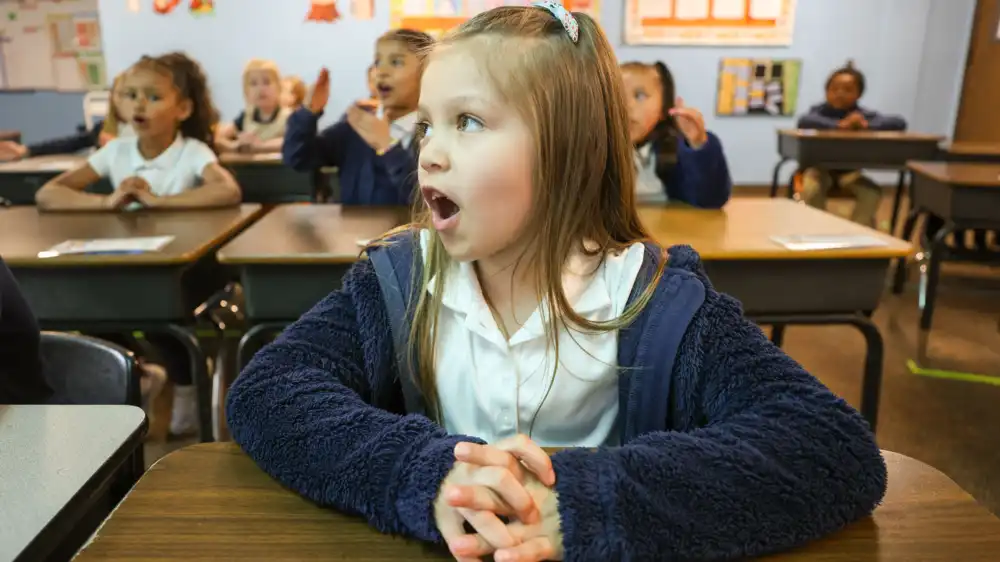
There are seven children sitting in small chairs.
One girl is so little her feet barely touch the floor.
Zig Engelmann: OK, let's do a little of these.
Their teacher is perched on the edge of a stool, at a blackboard, with a piece of chalk in his hand.
Zig Engelmann: What's eight plus two?
Kids: 10, 10.
Zig Engelmann: Eight plus two equal 10! Say it.
Kids: Eight plus two equal 10!
Zig Engelmann: What's ten plus two?
Kids: 12.
The kids do addition. They also do subtraction. And multiplication. And division.
Zig Engelmann: Wait ‘til you see this one.
They even do some basic algebra.
Zig Engelmann: What if I had something as hard as this? Seven plus R .…
Seven plus R equal eleven. He writes it on the board.
Zig Engelmann: Oh boy.
You can see the kids thinking. They're whispering to themselves. Using their fingers to count.
Kids: Four!
Zig Engelmann: That's it! Yo! Seven plus how many equal 11?
Kids: Seven plus four equal 11.
Zig Engelmann: Yeah. How'd you work that out?
Most kids aren't taught algebra until they're in middle school or even high school. But these kids haven't started elementary school yet.
These kids are in preschool.
Zig Engelmann: You go into a store, and you say, “I wanna buy a pie.” And the guy says, “That's fine because one fourth pie costs five cents.” How do I write it up?
The kids help their teacher as he writes an equation on the board.
Kids: …. equals five.
Zig Engelmann: Five. Go!
Kids: Count by five ….
The kids figure out the answer.
Zig Engelmann: So the answer is — if one fourth pie costs five cents, the whole pie costs ....
Kids: 20!
Zig Engelmann: 20 cents.
Boy: Wow.
A boy says, “Wow.”
Boy: You have to pay that much for a pie?
You have to pay that much for a pie?
The kids in this preschool classroom in 1966 were defying all kinds of expectations. Not just because of what they were learning, but because of who they were. They were Black children from a poor neighborhood. And a lot of people at the time — and still today — expected poor, Black children to struggle in school.
But the preschoolers you heard could do word problems and solve basic equations because they were taught how to do it.
Their teacher was a man who believed all kids could learn, if they were taught. He believed deeply in the power of instruction.
Kids: 52.
Zig Engelmann: 52. You want to do one more of those?
Kids: Yeah.
His lessons were intense. Fast-paced. Tightly structured.
And his way of teaching was controversial.
Critics said it was too much, that it might turn kids off to learning.
(Music)
But that's not how the little girl whose feet could barely touch the floor experienced it.
Yolanda Tillman: I mean, I remember that like it was yesterday.
Yolanda Tillman is in her 60s now. She loved the preschool. And the teacher.
Tillman: I was just so amazed with him, like, here I am this little girl. And this guy is teaching us.
He wasn't warm and fuzzy.
Tillman: He was firm. He meant business. You know, it was, we're here to learn, OK? And I'm going to teach you children, you're going to learn. And this is why we're here. We're not here for any other reason but to learn.
Yolanda says when she got to elementary school, she was way ahead of the other kids.
Tillman: The teachers used to be so amazed with the fact that I knew how to count by 5s and how to count by 10s and how, you know, how to do all these math problems.
She remembers the way she was taught in the preschool as different from the rest of her education.
Tillman: If I had had that type of teaching throughout my life, I don't know where it would have taken me. Like, I just feel like I would have went to a different level if I had had that type of teaching going all the way up through school.
She thinks more schools should teach this way.
(Music ends)
But the kind of teaching Yolanda Tillman got in her preschool never caught on in American education.
(Music)
Something quite different took hold.
Teacher 1: I've literally been told by my district that I should not be teaching math. I should be facilitating math.
Teacher 2: I was told very clearly that we are just there to present them with materials to explore. They can teach themselves.
Teacher 1: The children should be discovering math principles and teaching each other.
Teacher 3: Everyone is repeating this mantra of like — inquiry learning is best. And the majority of our kids are two to three grade levels behind.
(Music ends)
These are all teachers who wrote to us after Season 1 of this podcast. Season 1 was about how teaching kids to read went wrong.
(Music)
Teachers told us, it's not just reading. They said something's not right about how we're teaching math. And science. And history.
Something's not right about how we are teaching.
I'm Emily Hanford and this is Season 2 of Sold a Story, a podcast from APM Reports.
I've been an education reporter for nearly 20 years. And in all my years visiting classrooms, talking to educators, following policy debates, I've noticed something that might sound kind of strange.
In the United States, a lot of people don't believe that instruction matters that much when it comes to learning.
They believe other things matter more — things like the family a child grows up in, their neighborhood, their life circumstances.
And don't get me wrong — those things do matter.
But teaching matters too. And it can be more powerful than a lot of people realize.
That's what this season of the podcast is about.
(Music ends)
Like in Season 1, we're going to focus on an idea about teaching and learning.
In Season 1, we investigated education insiders who had an idea that turned out to be wrong.
This season, we're going to introduce you to an education outsider who turned out to be right.
(Music)
Doug Carnine: He drilled for oil, he owned some used car lots, he worked in the steel mill.
Owen Engelmann: He was very interested in Plato and Aristotle.
Kurt Engelmann: I don't think he ever uttered the word social justice, but it was at the center of what he did.
Linda Carnine: He really believed that all kids could learn. If the kid hasn't learned it, the teacher hasn't taught it. That was our basic rule.
More than 50 years ago, he got a chance to try to prove his ideas in a big government research project.
Kurt Engelmann: It was the largest educational experiment, at least that we know of, in the history of the world.
Russell Gersten: The idea is, let's try to find out what works.
Cathy Watkins: It didn't just evaluate different curricula or different instructional methods, it evaluated different philosophies of education.
It was a contentious experiment. A messy experiment. But the government's final report indicated there was one program that stood out above the rest.
Owen Engelmann: This is awesome! It's going to be disseminated everywhere.
That didn't happen.
Gary Davis: There's a wide range of people against it. It doesn't fit what they want education to be.
Powerful people disputed the findings and sought to discredit them.
Gene Glass: I find no evidence in the entire evaluation that they have anything special or worthy of wide distribution.
Jerry Silbert: It was like a, like a baseball bat to the head.
(Music ends)
That's what's coming up on Season 2 of Sold a Story.
We have seven episodes for you.
(Music)
In this first episode, I'm going to introduce you to the guy you heard doing algebra with 4-year-olds, and tell you how he went from working in a steel mill to teaching in a preschool.
That's after a break.
(Music ends)
**
(Music)
The man at the center of this story was named Siegfried Engelmann. Most people called him Zig.
He died in 2019, at the age of 87. You're going to hear his voice a lot in this podcast, but it's all from recordings we dug up. I never talked to him.
Zig Engelmann was born in 1931, on the South Side of Chicago.
1946 Chicago Promo Film: This is Chicago! A great empire set in the heart of America .…
His father was a doctor. His mother was a nurse. But he wanted to do something different.
1946 Chicago Promo Film: Large machinery plants are located in Chicago because of the abundant supply of skilled labor .…
When he was 15, Zig lied about his age to get a job at a steel mill.
Owen Engelmann: And he told the foreman, he goes, “Give me the toughest job, I'll take it.”
That was his son Owen.
Kurt Engelmann: And so ...
And this is his son, Kurt.
Kurt Engelmann: ... they put him in one of the most challenging places taking these big, red hot pieces of steel for plows coming off of the conveyor line.
Kurt and Owen are twins. Their dad liked to tell them stories about his life growing up. He was not very interested in school.
Kurt Engelmann: He was big into being an athlete. Weightlifting, bodybuilding.
He kind of loafed his way through high school. Wasn't sure what to do next. Finally, a friend decided to intervene.
Owen Engelmann: And he took him down to the University of Illinois and said, “You're gonna go to school.” “I don't want to go to this school. This is for ...” you know.
Zig saw himself as more of a blue-collar guy. Not a college kid.
Owen Engelmann: But once he embraced it, he did quite well in school.
He majored in philosophy. Thought that if he could understand the thinking of the great thinkers, he would be prepared to do anything.
But he still didn't know what that was. He didn't know what he wanted to do with his life.
Until the early 1960s.
Zig Engelmann: I was working as a marketing director for a medium-sized advertising agency. And they wanted to know how many repetitions it took for kids to learn something.
This is Zig Engelmann at a conference in 2008.
Zig Engelmann: This company that they were setting up a marketing plan for — the name was Hollywood Candy Company .…
Butter-Nut Candy Commercial, Hollywood Brands: (Singing) Well it's a candy bar that's solid buttery caramel, dad.
Zig Engelmann: And the president of this company, he asked a question — how many repetitions it took for kids to learn something from TV?
(Sound of commercial)
Zig Engelmann: I don't want to spend this money unless I'm pretty sure that I'm going to get my money's worth. How much are we talking about? How much exposure? So I had the job of looking up in the research libraries information about how much repetition it took. I couldn't find anything. Not a word. And so what we decided to do was get a little group of kids together and run some slogans and things by 'em and see how much they learned.
And pretty soon, he was more interested in teaching than he was in marketing.
Kurt Engelmann: He just was entranced with instruction and having kids learn.
Zig Engelmann: OK, boys, let's go.
He started math lessons with his twins when they were 3.
Zig Engelmann: Owen, you want to go first?
Owen Engelmann (as a child): 255 plus 297.
Zig Engelmann: Right.
The boys are 4 at this point. Their dad has set up a camera to film them. To show what he's taught them.
Zig Engelmann: OK, Kurt's turn.
Kurt has to figure out the area of a square.
Kurt Engelmann (as a child): We don't know how many square inches.
Zig Engelmann: Square inches, right.
Kurt Engelmann: We do some geometric problems. We do some basic algebra.
Kurt remembers the lessons as challenging. But fun.
Kurt Engelmann (as a child): So there's 36 square inches.
Zig Engelmann: That's right.
Kurt Engelmann: This was his first attempt at systematic teaching. He did do some with my older brother also.
His older brother Eric. It was in a lesson Zig tried with Eric that he had his first major insight about teaching.
Zig Engelmann: If they made a mistake, it was probably my fault.
This became his guiding principle.
(Music)
When a student doesn't understand something, it's probably not the student that's the problem — it's probably the teaching.
Here's the lesson he was doing with his son Eric when this first clicked for him.
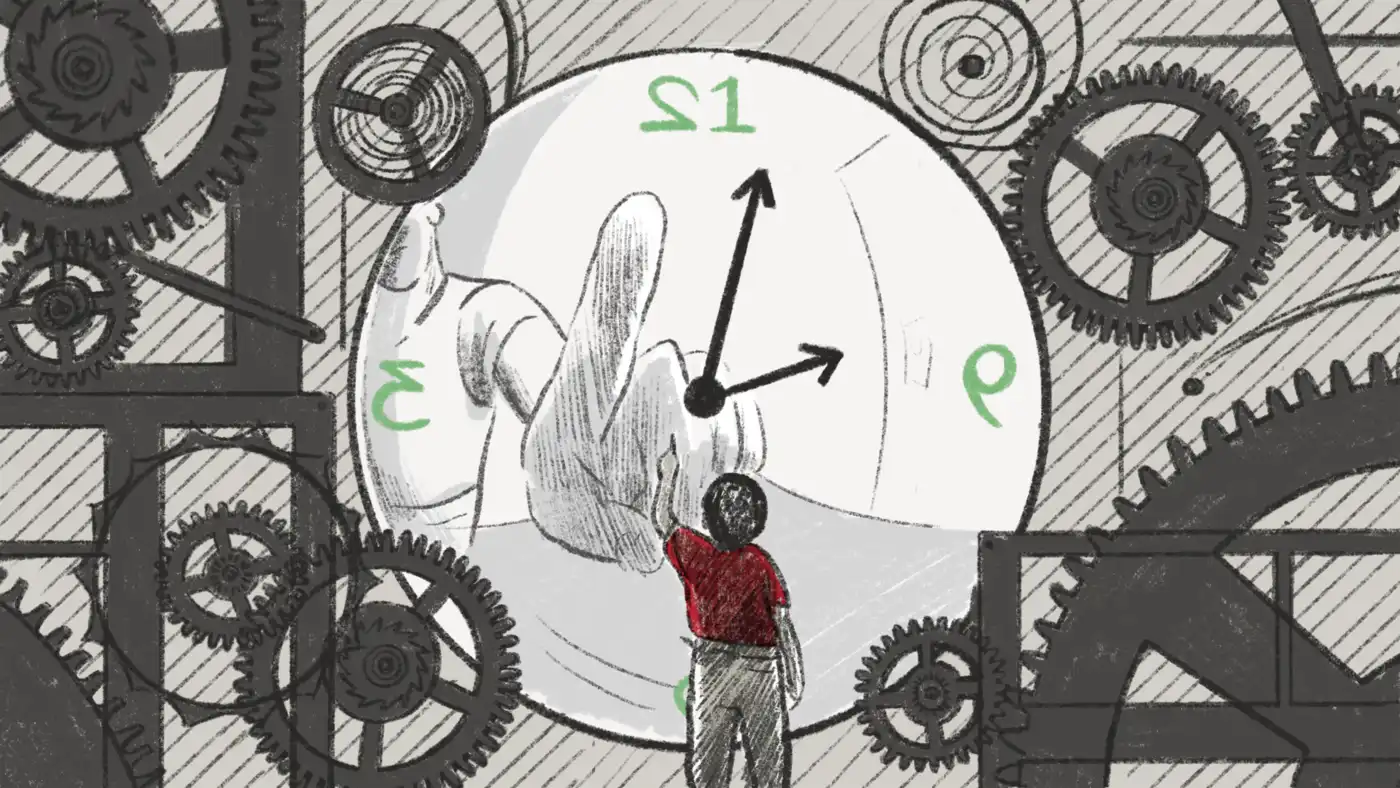
The lesson was about telling time. He was trying to teach Eric the concept of “after the hour.” It was the 1960s, so it was an old-fashioned clock, with an hour hand and a minute hand and a face.
Zig explained to Eric, “after the hour” is when the minute hand is on the right side of the clock's face.
Then he showed Eric examples and asked him — is this “after the hour?”
Kurt Engelmann: My father kept asking and Eric kept getting the incorrect answer.
Eric kept pointing to the left side of the clock's face.
And after a lot of frustration, Zig suddenly realized the problem.
Eric was answering the question from the wrong perspective. He was answering the question as if he were the clock. And if you are the clock, “after the hour” is not on the right side of your face.
Picture it.
If you are the clock, “after the hour” is on the left side of your face.
(Music ends)
Kurt Engelmann: And so what that demonstrated to my father was that learners can logically misinterpret your presentation. So, it has to be extremely clear. Otherwise, they will either get the wrong answer, or they won't understand what it is that you're trying to teach them.
Zig Engelmann now knew what he wanted to do with his life. He wanted to be a teacher.
But more than that, he wanted to design instruction. To make instruction clear. So that all kids could learn.
Zig Engelmann: I decided that I couldn't work in advertising anymore. I quit my job.
And he started looking for a job in education.
He thought his ticket was going to be that film he made of his twins doing math. He thought there'd be a lot of interest in what he'd been able to teach them.
Zig Engelmann: So I made up a list of, I don't remember, 20 names of institutions that I thought would be interested in the information I had and the knowledge that I had gained in designing instructional programs.
His list included universities and educational publishers. He sent them his film.
Zig Engelmann: I was rejected by all of them.
The only indication that anyone was the least bit interested in his film was when a guy from one of the publishing companies asked what kind of pen he used when he wrote out the math problems for his sons to solve.
Zig Engelmann: And I said, “Uh, it's a felt pen.”
So that place was a bust. But he had one more name on his list. One more educational institution to try for a job.
Zig Engelmann: The last place on the list was the place that seemed the most unlikely to me. It was the Institute for Research on Exceptional Children at the University of Illinois, which was renowned and which was in the news a lot.
It was one of the leading centers in the United States for studying how to help disadvantaged children do better in school.
Zig Engelmann: And so I figured, well, I may as well run the course and do the last one.
He sent them his film.
(Music)
This time, there was interest.
Carl Bereiter: So I tuned in and heard this thing and was very impressed by it.
This is Carl Bereiter, one of the professors at the research institute. He watched the film of Zig teaching his twins. And he was amazed that kids so young could do so much math. He didn't think that was possible.
Bereiter: I just thought something's happened here that's new, that we haven't seen before. And should find out whether it can be replicated.
He told his boss — we should give this guy Engelmann a job.
Zig Engelmann: And they hired me as a research associate. And I, yes! I was really happy.
(Music ends)
Zig Engelmann started work at the Institute for Research on Exceptional Children at the University of Illinois in 1964.
Here's how Carl Bereiter recalls one of his first meetings with Zig.
Bereiter: I laid out some of the experiments we had in mind. And he said, “Well, why don't we just wrap them all together and start a school?”
They decided to start a preschool where they would try to replicate what Zig had done with his sons.
But this time it was going to be a whole class of kids. Kids who were not expected to do well in school. The kids you heard at the beginning of this episode.
Zig Engelmann: How many minus 11 equal three?
Kids: 14 minus 11 equal three.
Zig Engelmann: All righty .…
But what Zig Engelmann was doing, the way he was teaching...
Zig Engelmann: OK, what if I did something that is much harder than that?
.... a lot of people didn't like it.
(Music)
Linda Carnine: It was totally new and totally controversial.
Doug Carnine: There was a terrific backlash against the program.
Walter Cronkite: One educator has called the approach totalitarian. Another, horrible.
Coming up, Zig's controversial preschool. And the roots of a heated debate about teaching that's still hovering over education today.
That's on Episode 2 of Sold a Story.
And you don't have to wait until next week to listen to it.
(Music ends)
Episode 2 is available right now.
(Music)
This season, I'm writing a weekly email newsletter to go along with each episode of the podcast. To start off, I wrote about how we decided on the topic for Season 2. You can sign up for the newsletter at soldastory.org/email. That information and a link to our website are also in the show notes.
Sold a Story is a podcast from APM Reports. It's reported and produced by me, Emily Hanford, with Emily Haavik, Christopher Peak, Kate Martin, Olivia Chilkoti and Carmela Guaglianone. Our story editor is Curtis Gilbert. Additional editing by Sasha Aslanian. Andy Kruse is our digital editor. Mixing, music and sound design by Chris Julin. Fact checking by Betsy Towner Levine. Our theme music is by the band Wonderly.
Final mastering by Derek Ramirez.
Our executive editor is Jane Helmke. Special thanks to Emily Corwin and the entire APM Reports team.
Thanks also to Margaret Goldberg, Cait Kelley, Dan Kraker and Annie Russell.
Leadership support for Sold a Story comes from Hollyhock Foundation and Oak Foundation. Support also comes from Ibis Group, Esther A. & Joseph Klingenstein Fund, Kenneth Rainin Foundation, Wendy and Stephen Gaal and the listeners of American Public Media.